🟢 UPDATED Medically Reviewed by: NILAY OMAR | Last Updated: March 2026
Tired of slipping dentures but worried about the cost and surgery of dental implants? Enter mini dental implants—often marketed as a faster, cheaper alternative among the various types of dental implants. But are mini dental implants worth it in the long run, or just a temporary fix? For the benefits as well as the limits, see our complete mini dental implants guide.
While these minimally invasive implants offer immediate stabilization for some, they have structural limitations that can lead to implant failure and costly revision surgeries if used on the wrong patient. This guide covers the true costs, risks, reviews, and success rates to help you decide safely.
💡 Quick Takeaways:
Best For: Stabilizing lower dentures or temporary anchorage.
Not For: Heavy chewing or permanent full-mouth restorations.
Cost: 50%–60% less upfront than standard implants.
Lifespan: 5–9 years (standard implants last a lifetime).
📲 Questions about your case? Chat with our specialists on WhatsApp for a free answer.
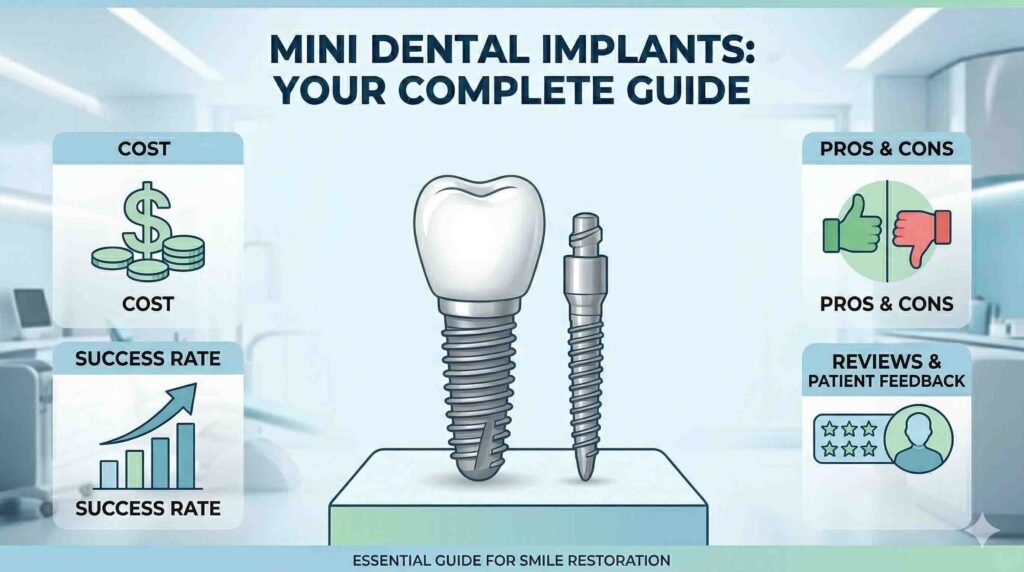
Table of Contents
ToggleThe Secret to Faster Smiles: What Are Mini Dental Implants?
What are mini dental implants? At their core, mini dental implants are ultra-narrow titanium alloy screws designed to act as artificial tooth roots. Often functioning similarly to temporary anchorage devices (TADs) in orthodontics, they serve a highly specialized purpose in restorative dentistry.
How They Differ From Standard Implants
The primary difference is their size:
Standard Implants: Typically 3.5mm to 6mm in diameter.
Mini Implants: Usually less than 3mm wide.
Because of their narrow diameter, they rely heavily on immediate mechanical grip within the jawbone, rather than the deep, structural bone fusion (osseointegration) that firmly secures traditional Endosteal vs Subperiosteal implants over several months.
Why They Are Considered Minimally Invasive Implants
Because they are so small, placing them often does not require an incision or stitches in the gums. They can be placed directly through the soft tissue into the bone, which significantly reduces initial surgical trauma and categorizes them as minimally invasive implants.
Common Uses
Denture Stabilization: Most frequently used to stabilize a loose lower denture.
Tight Anatomical Spaces: Occasionally, they are used for single tooth mini dental implants in very tight anatomical spaces, such as replacing a lower front incisor. (Note: Depending on the size of the gap, a dentist might also suggest the Bridging of Teeth as a reliable alternative).
The Trade-Off: Weighing the Mini Dental Implants Pros and Cons
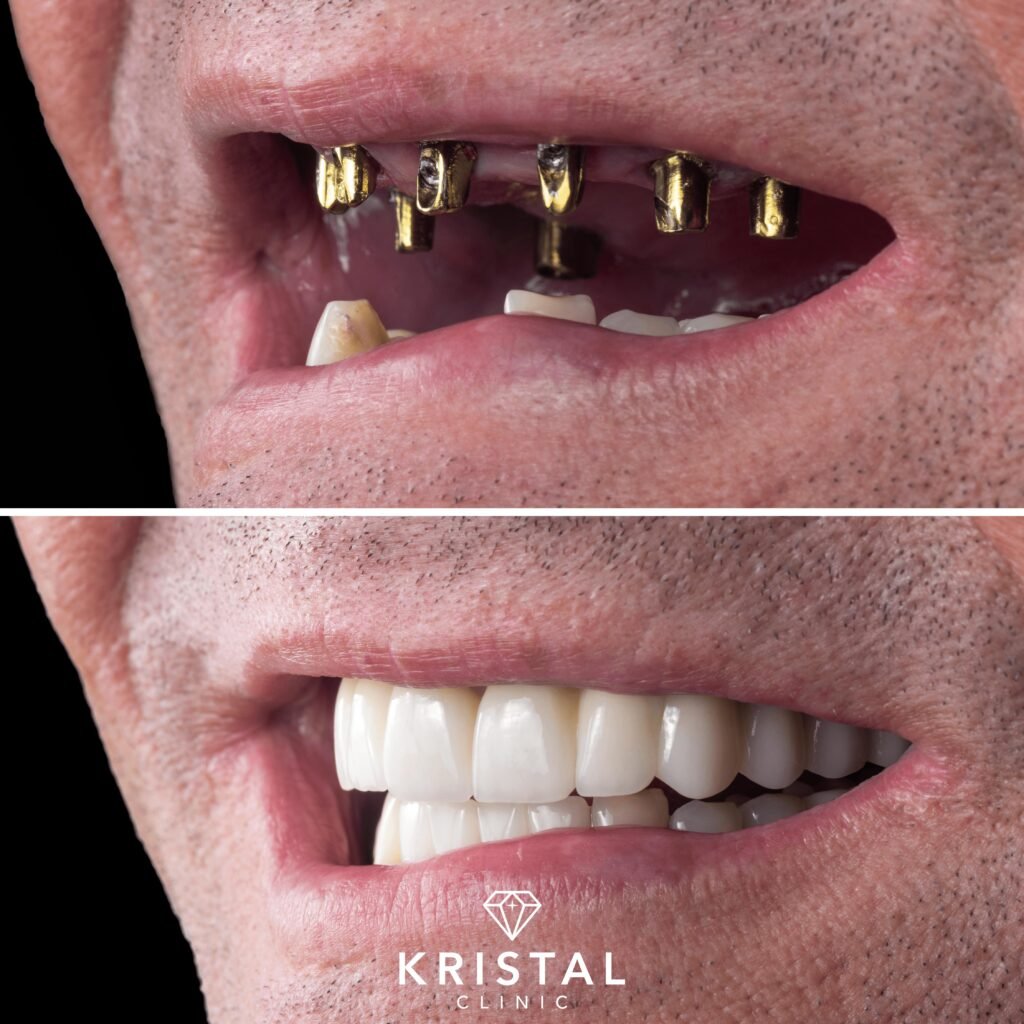
Understanding the mini dental implants pros and cons is crucial before committing to this procedure. Their physical limitations strictly dictate their long-term success.
The Main Advantages:
Less Surgery: They require no flaps or stitches, making recovery a breeze.
Rapid Placement: The procedure is often completed in a single, fast visit.
Lower Upfront Price: They cost significantly less than traditional implants on day one.
The Hidden Limitations (The Disadvantages):
Higher Fracture Risk: Due to their narrow diameter, the titanium alloy is more prone to bending or snapping under heavy bite pressure (psi).
Bone Loss Risk: Because they do not fully osseointegrate, the constant micro-movements of the implant under chewing forces can lead to crestal bone loss over time.
Not for Heavy Chewing: They simply cannot withstand the force required to replace your heavy-duty back molars.
Are You a Match? Who Is a Good Candidate?
Not everyone qualifies for this shortcut. Proper patient selection is the single biggest factor in preventing implant failure.
Best Candidates: Elderly patients who cannot safely undergo extensive surgery, patients with very narrow tooth gaps, or those looking to secure a loose lower denture who lack the bone volume for standard implants and desperately want to avoid Bone Grafting Procedures.
Poor Candidates: Patients who heavily grind their teeth (bruxism) or are seeking a permanent, fixed full-arch cosmetic transformation.
🦷 Wondering if your jawbone is strong enough for implants?
You don’t have to guess. Message our medical team on WhatsApp and send us your panoramic X-ray for a free, no-obligation evaluation of your bone density and candidacy.

The Financial Breakdown: Understanding the Mini Dental Implants Cost
When evaluating restorative options, the mini dental implants cost is usually the most attractive feature for patients. To see how these prices compare to top-tier traditional options, you can review the Best Dental Implants 2026: Expert Brand & Cost Comparison.
Budgeting for Your Smile: What Is the Average Cost of Mini Dental Implants?
In the US and UK, the average cost of mini dental implants typically ranges between $500 and $1,500 per implant. This makes them about 50% to 60% less expensive upfront than standard-diameter implants.
The final price fluctuates based on the number of implants needed and the specific hardware used. (Unsure how the hardware connects? Read What Is the Abutment in Dental Implants to understand the O-rings used to snap the prosthetic in place).
The Hidden Risks: Beware the “False Economy”
Be wary of the “false economy.” While the upfront price is lower, long-term replacement costs can be steep. If a mini implant fails or fractures below the gumline, the complex revision surgery required to extract it and rebuild the bone will quickly make your total lifetime cost much higher than if you had initially chosen a standard, permanent implant.
The Ultimate Showdown: Mini Dental Implants vs Regular Dental Implants
When comparing mini dental implants vs regular dental implants, the differences come down to physics, biology, and premium material options. For instance, standard implants allow patients to choose between Titanium vs Zirconia Materials, while mini implants are strictly titanium.
| Feature | Mini Dental Implants | Regular (Standard) Implants |
| Primary Use | Denture stabilization, temporary anchorage | Permanent tooth replacement, fixed bridges |
| Bone Required | Can be placed in narrow, less dense bone | Requires adequate width (or bone grafting) |
| Bite Strength | Limited; prone to failure under heavy psi | Maximum; functions exactly like natural teeth |
| Lifespan | 5 to 9 years (on average) | Designed to last a lifetime (20+ years) |

Beyond the Hype: Real Mini Dental Implants Reviews and Success Rates
Prospective patients seeking mini dental implants reviews will often find a “split decision” on long-term satisfaction. We’ve summarized the two distinct viewpoints you’re likely to encounter.
The Viewpoint of Successful Patients
Patients in this group prioritized immediate stability and lower cost over finding a decades-long “permanent” solution. Their positive reviews generally reflect realistic expectations.
Glowing reviews focus on:
Immediate Stability: The relief of finally stabilizing a loose lower denture.
Lower Cost: The significantly more accessible price point compared to traditional implants.
Faster Recovery: A quicker, less invasive procedure with no major bone grafting.
Bottom Line: These patients were happy because they were seeking an affordable, intermediate solution and got exactly that.

The Data Speaks: What Is the Success Rate of Mini Dental Implants?
Patients actively asking what is the success rate of mini dental implants should look closely at the long-term clinical data. Short-term success is very high (often above 90% in the first few years). However, the long-term success rate drops significantly compared to standard implants, especially when subjected to excessive chewing force or placed in patients with poor oral hygiene.
Mini vs. Standard Implants: The Honest Comparison
This is the core of the decision for many. Let’s look at them side-by-side.
| Feature | Mini Dental Implants | Standard Dental Implants |
|---|---|---|
| Cost | Lower ($400 – $2,500 per implant) | Higher ($1,500 – $6,000+ per implant) |
| Invasiveness | Minimally Invasive | More Invasive Surgery |
| Bone Requirement | Low | Significant |
| Procedure Time | Shorter (Often 1-2 hours for a set) | Longer |
| Healing Time | Faster | Longer |
| Best For | Denture Stabilization, Narrow Spaces | Single Molars, High Bite Force |
| Long-Term Data | Good (10-15+ years) | Excellent (25+ years) |
When a Dental Bridge Might Be a Better Alternative:
If the teeth adjacent to your gap already need crowns, a bridge could be a viable option. However, it requires grinding down healthy tooth structure, which is a permanent alteration. Our guide on implants vs bridging of teeth delves deeper into this critical choice. Mini implants for a single tooth preserve the health of your neighboring teeth, which is a significant advantage.
M Sarraf, E Rezvani Ghomi, S Alipour… – Bio-design and …, 2021 – Springer. A state-of-the-art review of the fabrication and characteristics of titanium and its alloys for biomedical applications. springer.com
Cited by 302
A Kurup, P Dhatrak, N Khasnis – Materials Today: Proceedings, 2021 – Elsevier. Surface modification techniques of titanium and titanium alloys for biomedical dental applications: A review. mitwpu.edu.in
Cited by 164
A Bandyopadhyay, I Mitra, SB Goodman… – Progress in materials …, 2023 – Elsevier. Improving biocompatibility for next generation of metallic implants. sciencedirect.com
Cited by 221
A Farrahnoor, H Zuhailawati – International Journal of Materials …, 2021 – degruyter.com. Review on the mechanical properties and biocompatibility of titanium implant: The role of niobium alloying element. researchgate.net
Cited by 13
JV Calazans Neto, CAS Celles… – ACS Biomaterials …, 2024 – ACS Publications. Recent advances and prospects in β-type titanium alloys for dental implants applications. acs.org
Cited by 6