
Reviewed by:
Dr. Abdulrahman Nabaa, University and science and Technology in Abu Dhabi , UAE
Dentist
Last Reviewed: Jan 30, 2026
Next Scheduled Review: March 15, 2027
This article is medically reviewed and written to comply with current clinical documentation standards for implant dentistry.
Table of Contents
ToggleQuick Definition
The all on 4 dental implants procedure is a precision surgical protocol for full-arch restoration where a fixed, non-removable prosthesis is supported by four titanium implants. This all on four implants procedure uses two posterior implants angled up to 45 degrees to maximize existing bone and avoid sinuses or nerves, while two anterior implants are placed vertically.
This design achieves sufficient primary stability (35–45 Ncm of torque) to support a temporary bridge placed within 24 hours — a concept known as getting your smile back fast with immediate function.
📅 Confused by the options? All-on-4 is a big decision. Skip the Google search and get clear answers. Schedule a 15-minute Discovery Call with our team to see if this fits your lifestyle. Check Discovery Call Availability
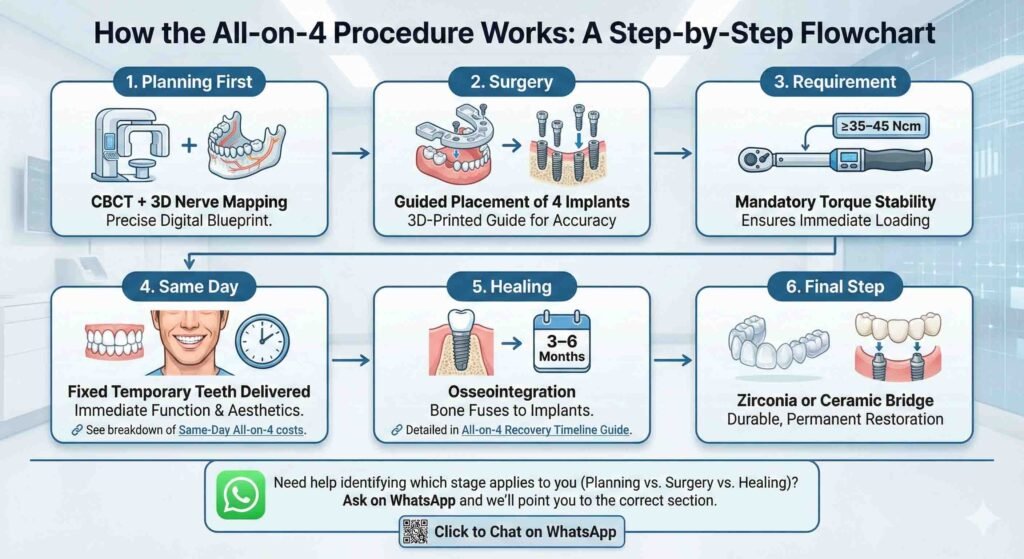
How the All-on-4 Procedure Works
Planning first: CBCT + 3D nerve mapping
Surgery: Guided placement of 4 implants
Requirement: ≥35–45 Ncm torque
Same day: Fixed temporary teeth — see our breakdown of Same-Day All-on-4
Healing: 3–6 months osseointegration — detailed in our all on 4 dental implants recovery timeline guide
If you want immediate-loading context in plain language, see All-on-4: Get Your Smile Back Fast.
💬 Not sure where your case fits in the steps above?
Send one question on WhatsApp and we’ll point you to the right stage of the process
Phase 1: Digital Surgical Planning – The 3D Blueprint
Before the physical all on 4 dental implants surgery begins, a digital blueprint is created. A CBCT scan generates a 3D model of the jaw, allowing surgeons to perform virtual nerve-mapping of the inferior alveolar nerve and maxillary sinus floor with 1–2 mm safety margins.
This stage of the all on 4 dental implants process determines:
Exact implant positions
30–45° posterior angulation
Bone-to-implant contact optimization
From this data, a static surgical guide is 3D-printed to ensure the all on 4 procedure is executed with sub-millimeter accuracy. This precision is what distinguishes this technique from other types of dental implants available for tooth replacement.
Visualization: Imagine your jawbone as a topographical map. The surgeon digitally places four “skyscraper foundations” on the strongest terrain. The two posterior foundations tilt forward, anchoring into dense anterior bone while safely bypassing the sinus cavity.

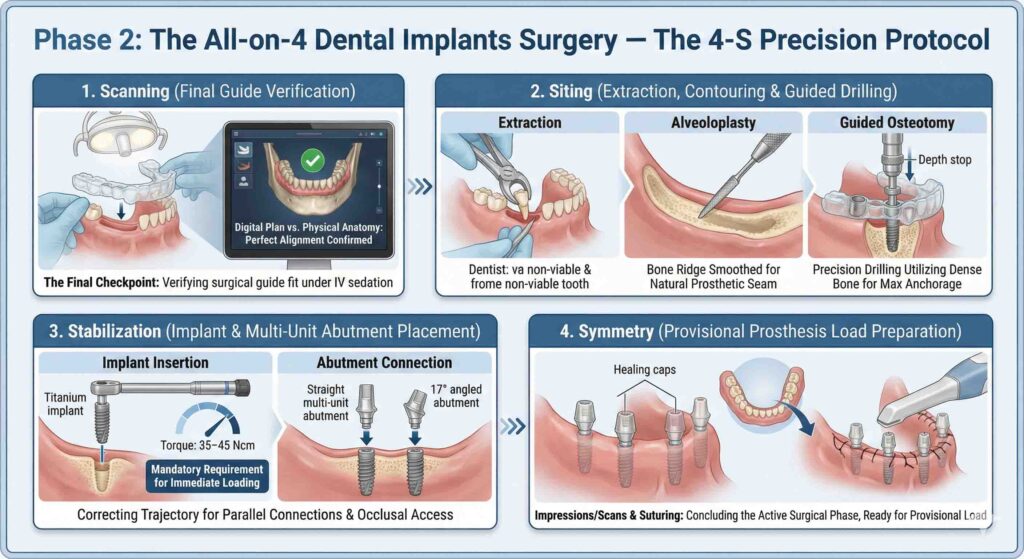
Phase 2: The All-on-4 Dental Implants Surgery — The 4-S Precision Protocol
Step 1: Scanning (Final Guide Verification)
Under IV sedation, the sterile surgical guide is seated. This confirms the digital plan aligns perfectly with physical anatomy —the final checkpoint in the dental implants all on four technique.
Step 2: Siting (Extraction, Contouring & Guided Drilling)
Extraction:
Remaining non-viable teeth are removed.Alveoloplasty:
The bone ridge is smoothed to define the gingival transition line, ensuring the all in four dental procedure results in a hidden, natural-looking prosthetic seam.Guided Osteotomy:
Following the all on 4 dental implants procedure steps, guided drills prepare the sites while utilizing dense anterior bone for maximum anchorage.
Step 3: Stabilization (Implant & Multi-Unit Abutment Placement)
Implant Insertion:
All four implants are threaded into place. Achieving 35–45 Ncm of torque is a mandatory requirement for immediate loading.Abutment Connection:
Multi-unit abutments (straight or 17° angled) correct implant trajectory, creating parallel prosthetic connections and allowing screw access through occlusal surfaces — not the visible front teeth.
Step 4: Symmetry (Provisional Prosthesis Load Preparation)
Healing caps are placed, impressions or scans are taken, and suturing is completed. This concludes the active surgical phase of the all on 4 dental implants surgery time.
Phase 3: The All-on-4 Dental Implants Laboratory Procedure
The lab phase typically occurs the same day, especially when immediate loading is appropriate.
Same-day conversion process (what happens):
A pre-made denture is connected to titanium cylinders
Bite (occlusion) is adjusted
The bridge underside is shaped with hygiene geometry (often convex to reduce plaque traps)
A fixed acrylic temporary bridge is delivered
⏱ Total procedure time: typically 5–8 hours per arch (includes surgery + lab conversion).
For a more detailed walk-through, see the All-on-4 procedure step-by-step guide (2026).
The All-on-4 Dental Implants Timeline
| Stage | What Happens |
|---|---|
| Day 0 | Surgery + fixed temporary bridge (when safe) |
| Weeks 1–2 | Soft-tissue healing |
| Months 1–6 | Osseointegration + bite adaptation |
| Month 6+ | Final zirconia or ceramic bridge |
During months 1–6, the brain closes the “proprioception gap,” relearning spatial awareness of fixed teeth. To see the aesthetic results of this healing journey, you can view our before and after all on 4 dental implants guide.
Respecting this biological phase is the key factor that ensures long-term implant success rates exceed 95%. This emphasizes why clinicians prioritize controlled chewing progression during healing.
Clinical insight (information gain):
During months 1–6, many patients experience a “proprioception gap” — the brain adapts to fixed teeth and relearns bite force and spatial awareness. This is one reason clinicians emphasize controlled chewing progression during healing.
For a clear, patient-friendly breakdown of recovery, see the All-on-4 recovery timeline guide.
📩 Want a personalized timeline estimate based on your situation?
Message us on WhatsApp and we’ll tell you what typically affects healing time (bone density, smoking, medical factors)
Clinical Specifications at a Glance
| Aspect | Specification | Purpose |
|---|---|---|
| Primary stability | 35–45 Ncm | Enables immediate loading when safe |
| Posterior angulation | 30–45° | Avoids sinuses & nerves, maximizes bone |
| Bone requirement | Often D2–D3 density | Mechanical lock / stability |
| Surgical time | 5–8 hours | Surgery + lab conversion |
| Temporary phase | 3–6 months | Healing + integration |
| Final prosthesis | Zirconia / ceramic (varies) | Strength + aesthetics |
| Protocol | Malo Clinic concept | Evidence-based framework |
While the technical details are vital, many patients first ask about the financial investment. You can find detailed figures in our All-on-4 dental implants cost 2026 price guide, or explore our flexible payment plans and financing options.
Risks & Limitations
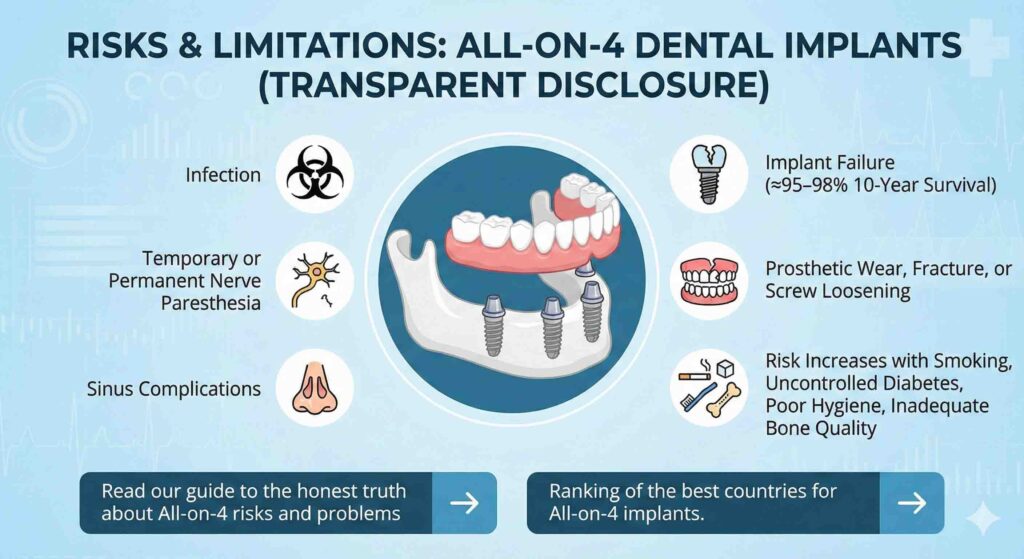
The all on four implants procedure, like all professional dental implants services, carries inherent risks:
Infection
Temporary or permanent nerve paresthesia
Sinus complications
Implant failure (≈95–98% 10-year survival)
Prosthetic wear, fracture, or screw loosening
Risk increases with smoking, uncontrolled diabetes, poor hygiene, or inadequate bone quality.
read our guide to the honest truth about All-on-4 risks and problems .
and If you are considering traveling for care to mitigate costs while maintaining safety standards, we recommend reading our ranking of the best countries for All-on-4 implants.
🟢 If you’re worried about a specific risk (sinus, nerve, diabetes, smoking), you can message your question on WhatsApp and we’ll direct you to the safest, most relevant info
Clinical Disclaimer
This article is for educational purposes only. Treatment planning and candidacy determination require a full clinical examination by a licensed oral surgeon or prosthodontist. Individual outcomes vary.
Frequently Asked Questions
What are the steps to the All-on-4 dental implants?
The all on 4 dental implants procedure follows a structured, step-by-step protocol:
Digital surgical planning with CBCT and 3D nerve mapping
Guided implant placement (two vertical anterior, two angled posterior)
Achieving primary stability (35–45 Ncm torque)
Multi-unit abutment connection
Same-day temporary bridge placement
Osseointegration and final prosthesis delivery after healing
How long is the procedure for All-on-4 dental implants?
The all on four dental implants procedure time typically ranges from 5 to 8 hours per arch.
This includes:
Surgical placement
Bone contouring
Implant stabilization
Intraoperative laboratory conversion for the temporary bridge
How long does it take to recover from all on four dental implants?
Initial recovery from the all on four dental implants procedure usually takes 7–14 days for soft tissue healing.
Full biological recovery (osseointegration) occurs over 3–6 months, after which the final zirconia or ceramic bridge is placed.
How painful is all on four dental implants?
The all on four dental implants procedure is performed under IV sedation or general anesthesia, so patients do not feel pain during surgery.
Post-operative discomfort is typically mild to moderate and managed with prescribed medication. Most patients resume normal daily activities within a few days.
How long does it take for all on four implants to heal?
Healing after the all on 4 dental implants procedure time typically takes 3 to 6 months. During this phase, the implants fuse with the jawbone (osseointegration). Patients can eat soft foods early on and gradually return to normal eating as healing progresses.
References & External Sources
Nobel Biocare – All-on-4® Treatment Concept
American Academy of Implant Dentistry (AAID)