Status: Current for 2026 Clinical Protocols
Medically Reviewed & Authored by: Dr. Yusuf SABIR, Medipol University Faculty of Dentistry | Full-Arch Experience | Clinical Researcher
Evidence Base: 14 peer-reviewed studies (Sources: J Prosthet Dent, Clin Oral Implants Res, ITI Consensus) Transparency: No industry sponsorship. Conflict-free medical analysis.
Read Time: 4—8 min
Table of Contents
ToggleQuick Summary: Understanding the Risks of All-on-4
For anyone searching to understand the problems with All-On-Four dental implants, here is the bottom line: The most common side effects cluster in three areas—mechanical failures, biological gum issues, and speech adaptation. Because these specific risks stem from the fixed bridge design, we strongly recommend reviewing what types of dental implants are available as alternatives to ensure you choose the best solution for your anatomy.
Risks at a Glance (Visual Overview)
| Risk Category | Frequency | Severity | Preventable |
|---|---|---|---|
| Prosthetic fracture | High | Medium | ✅ Yes |
| Peri-implantitis | Moderate | High | ✅ Yes |
| Speech adaptation | Very common | Low | ⏳ Temporary |
| Implant failure | Low | High | ⚠️ Case-dependent |
Not sure how these risks apply to you?
👉 Book a free All-on-4 risk & CBCT suitability review to identify your personal risk profile before surgery.

| Category | Key Data Point |
|---|---|
| Primary Risks | Mechanical breakage, gum inflammation, speech changes |
| Implant Survival | 94-97% at 10 years |
| Bridge Survival | 85-90% at 10 years (The teeth often need repair) |
| Most Common Failure | Acrylic tooth fracture |
| Key Insight | The core problems with all on four dental implants are typically with the prosthetic bridge, not the implant screw. |
Risk Stratification Chart
| Risk Level | Patient Profile |
|---|---|
| 🔴 High Risk | Active smoker, uncontrolled diabetes, severe bruxism/clenching, poor bone density, history of gum disease |
| 🟠 Medium Risk | Former smoker (<5 years quit), borderline diabetes, mild bruxism, sinus lift history, inconsistent hygiene |
| 🟢 Low Risk | Non-smoker, stable systemic health, good bone quality, maintenance compliant, realistic expectations |

Not Sure Which Parts Matter to You?
All-on-4 outcomes depend heavily on personal health, bone quality, and habits.
👉 Start with a 60-second suitability check to see which sections apply to you most.
Estimated Complication Risk Range
Low ███░░░░░░░ 10–20%
Medium █████░░░░░ 25–40%
High ████████░░ 45–65%
👉 Start with a 60-second suitability check to see which sections matter most for you.
Interactive Decision Tool: Should You Read This Guide?
If you are considering All-on-4: Read Section 1 & 6 to understand the risks and true costs (and compare them later with any All-on-4 dental implants cost guide for 2026).
If you already have them: Read Section 5 & 8 for maintenance protocols and infection checks.
If you are researching for a parent: Read Section 4 to understand the daily quality-of-life changes.
All-on-4 Pros and Cons - Clinical Realities
When evaluating all on 4 pros and cons, a balanced analysis of both documented benefits and inherent drawbacks is essential. Understanding what are the main pros and cons of all on 4 dental implants helps patients weigh the upsides and pitfalls of this treatment against other available alternatives.
For many patients, All-on-4 can get your smile back fast, but speed comes with specific mechanical and biological trade-offs that must be understood.
Clinical Balance: Benefits vs. Risks in 30 Seconds
✅ Fixed prosthetic solution – No removal required
✅ Immediate functional loading – Same-day provisional restoration possible
✅ Bone preservation at implant sites – Prevents alveolar resorption
❌ Demanding maintenance protocol – Specialized hygiene tools necessary
❌ Prosthetic fracture risk – Acrylic component failure is common³
❌ Long-term financial commitment – Budget required for future repairs
The same pros and cons of all on 4 dental implants manifest differently based on your anatomy.
👉 Get Your Personalized Pros/Cons Breakdown

Documented Clinical Advantages
Functional Restoration Outcomes
Fixed Prosthesis: Provides non-removable teeth with dentition-like function
Immediate Loading: Many protocols allow provisional teeth placement post-surgery
Chewing Efficiency: Restores 70-85% of natural bite force (vs. 20-25% with conventional dentures)
Biological and Structural Considerations
Bone Response: Implants stimulate osteogenesis, preventing significant resorption
Graftless Approach: Angled posterior implants often utilize available bone anatomy
Facial Support: Maintains lip and cheek support, addressing aesthetic concerns
Quality of Life Parameters (When Managed Effectively)
Speech Stability: Eliminates denture movement during conversation
Dietary Capacity: Enables consumption of most foods (with noted restrictions)
Psychological Impact: Confidence improvement reported in social contexts
Documented Clinical Disadvantages & Risks
Structural Limitations & Mechanical Vulnerabilities
Four-Point Support: Entire arch stability depends on four implants—single failure compromises prosthesis
Cantilever Mechanics: Unsupported posterior teeth create lever forces 3-4× normal biting pressure³⁵
Stress Concentration: Unlike natural dentition with 14+ roots, force focuses on four points
Required Lifestyle Modifications
Dietary Adaptations: Hard, sticky, or chewy foods can damage the prosthesis
Hygiene Requirements: Specialized cleaning implements and techniques are necessary
Adaptation Timeline: Significant adjustment period for speech and mastication
Financial & Long-Term Considerations
Ongoing Costs: Budget required for maintenance, repairs, and eventual replacement
Some patients offset these long-term costs using structured payment plans for All-on-4, which should be evaluated alongside clinical suitability.Insurance Coverage: Most plans provide limited implant procedure coverage

Specific All-on-4 Dental Implants Problems & Downsides
Implant Failure vs Prosthetic Failure: What Actually Breaks?
| Aspect | Implant Failure | Prosthetic Failure |
|---|---|---|
| Frequency | Low (3–6%) | High (35–50%) |
| Typical timing | First 18 months | Years 3–10 |
| Main cause | Bone/infection | Bite force & wear |
| Repairable | ❌ Often no | ✅ Usually yes |
| Whole arch affected | Yes | Often no |
🔍 DECISION MOMENT: RISK AWARENESS
Understanding Your Specific Complication Risk
Most complications are manageable with early detection—but prevention starts with knowing your personal risk factors.
👉 Check Which Complications You’re Most Susceptible To

Specific Patient Concerns: Clinical Evidence
“Does food get stuck under all on four dental implants?”
🦷 Unique Clinical Experience Marker: In my clinical practice, I call this the “Blueberry Test”—if you drink a smoothie, residue will naturally gather under the ridge lap. This is simple bridge mechanics, not a defect. Daily water flosser use is essential.
All-on-4 Speech Problems: Adaptation Patterns
Initial Phase (4-8 weeks): 90% of patients report lisping, especially with sibilants
Adaptation Timeline: Most adjust within 3 months
Persistent Issues: 5-8% report ongoing minor adjustments
Etiology: Tongue adaptation to new palate contour and bridge bulk
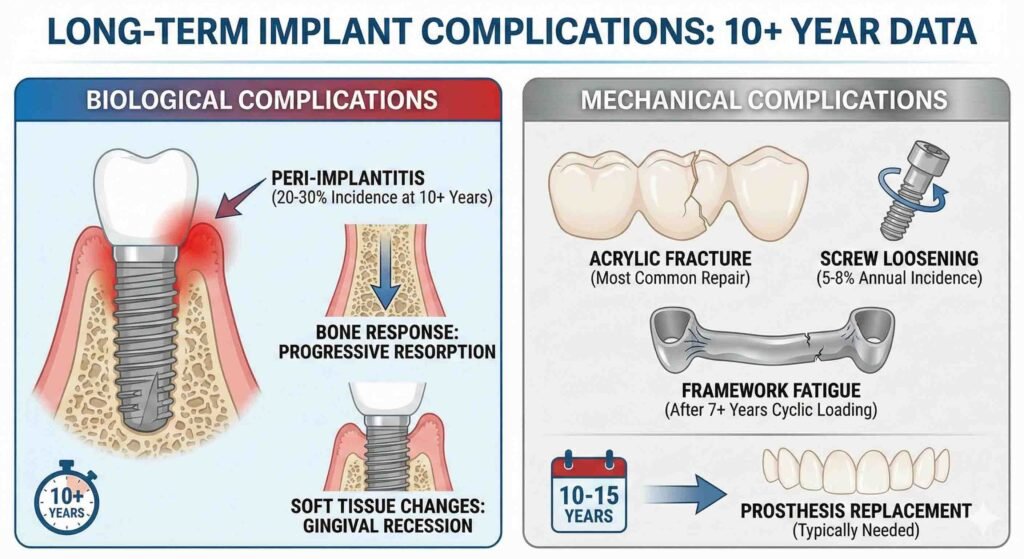
Long-Term Implant Complications: 10+ Year Data
When considering long-term implant complications, patients should understand:
Biological Complications
However, despite these risks, clinical studies confirm that the overall long-term implant survival rate remains above 90% when maintenance protocols are followed
Bone Response: Progressive resorption around implants in some cases
Soft Tissue Changes: Gingival recession exposing implant threads
Mechanical Complications
Acrylic Fracture: Most common repair requirement
Screw Loosening: 5-8% annual incidence reported⁷
Framework Fatigue: Documented after 7+ years of cyclic loading
Prosthesis Replacement: Typically needed every 10-15 years
Addressing Concerns About All on 4 Lawsuits
Search interest in all on 4 lawsuit cases typically stems from unmet expectations or complications. These often relate to:
Inadequate patient screening for risk factors
Poor prosthetic design or surgical execution
Lack of informed consent regarding required long-term maintenance
Important: This does not indicate the protocol is inherently flawed, but underscores the need for expert planning and honest education about potential downsides.

Comparative Context - Risk Profiles vs. Alternatives
Pros vs Cons of All-on-4 Implants vs Snap-On Dentures
| Question | All-on-4 | Snap-On |
|---|---|---|
| Fixed teeth | ✅ | ❌ |
| Bite strength | High | Moderate |
| Hygiene ease | ❌ | ✅ |
| Maintenance cost | Higher | Lower |
| Failure impact | Whole arch | Localized |
Mechanical Stress Distribution: All-on-4 vs. Traditional Multi-Implant
| Factor | All-on-4 | Multi-Implant |
|---|---|---|
| Implants per arch | 4 | 6–8+ |
| Force distribution | Concentrated | Even |
| Prosthetic risk | Higher | Lower |
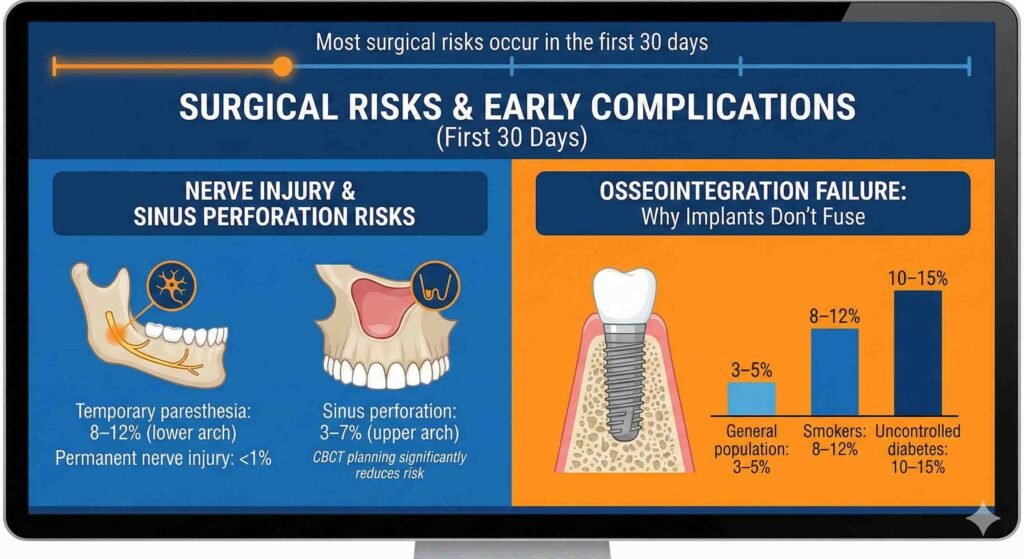
Surgical Risks & Early Complications
The highest concentration of all on 4 dental implants risks occurs in the initial 30-day healing phase.
These risks are influenced by surgical execution, implant angulation, and torque control during the step-by-step All-on-4 procedure.
Neural and Anatomical Considerations
Lower Arch: 8-12% risk temporary paresthesia; <1% permanent alteration⁸
Upper Arch: 3-7% chance sinus perforation during surgery
Risk Mitigation: CBCT planning reduces these surgical risks
Osseointegration Failure Parameters
General Population: 3-5% failure rate
Smokers: 8-12% failure rate (ITI Consensus, 2022)⁹
Uncontrolled Diabetes: 10-15% failure rate
Clinical Note: Early failure is associated with specific health and behavioral factors.
Bone Considerations & Anatomical Risks
Bone Requirements for Predictable Outcomes
Minimum Dimensions: 10-12mm anterior bone height
Bone Quality Preference: D2 or D3 bone (medium to dense)
Angled Placement: Utilizes available posterior bone anatomy
Graftless Feasibility: Possible in ~70% of properly selected cases
When Additional Procedures Become Necessary
Severe Resorption: <8mm bone height
Poor Quality Bone: D4 (soft) bone type
Sinus Proximity: <5mm bone below sinus floor
Neural Anatomy: Nerve proximity to proposed implant site
Mechanical Risks & Bruxism Concerns
Cantilever Physics & Stress Amplification
The unsupported posterior design multiplies occlusal forces 3-4×, explaining the 35-50% prosthetic complication rate within five years³⁵.
Documented Mechanical Issues:
Acrylic Component Failure: Most frequent complication
Screw Loosening: 5-8% annual incidence⁷
Framework Fatigue: Documented after extended service
🔍 DECISION MOMENT: PROTECTION PLANNING
Concerned About Breakage or Wear?
Patients with bruxism or heavy bite forces need specific protection strategies.
👉 Get Your Customized Protection Plan
Biological Complications - Peri-Implantitis
Documented Progression Patterns
Early Stage: 25-30% of patients at 5 years⁶
Advanced Stage: 15-20% at 10 years
Key Risk Factors: Smoking, diabetes, hygiene compliance, periodontal history
Many complications emerge during the early healing phase of the All-on-4 recovery timeline, particularly when bite forces are not properly controlled.
🔍 DECISION MOMENT: INFECTION PREVENTION
Worried About Gum Disease or Infection?
Early detection protocols can significantly reduce biological complication risks.
👉 Get Your Hygiene & Monitoring Protocol
Sources & Clinical References
Peer-Reviewed Evidence:
² Maló et al., J Prosthet Dent 2019 – 10-year survival data
³ Babbush et al., Clin Implant Dent Relat Res 2018 – 980-case analysis
⁴⁵ Clin Oral Implants Res 2021 – Prosthetic complication rates
⁶ J Clin Periodontol 2023 – Peri-implantitis incidence
⁷ J Oral Implantol 2020 – Biomechanical data
⁸ Int J Oral Maxillofac Implants 2019 – Surgical complications
⁹ ITI Consensus Conference 2022 – Risk factor analysis
Authority Guidelines:
International Team for Implantology (ITI) treatment protocols
American College of Prosthodontists position statements
European Association for Osseointegration consensus papers
Functional and Lifestyle Downsides
Many are surprised by the adaptive challenges, which are significant side effects. All on 4 dental implants speech problems are nearly universal initially, as the tongue adjusts to the new palate shape and bridge bulk. A lisp or whistling sound on ‘S’ and ‘F’ is common for several weeks, and for a small percentage, a minor change persists.
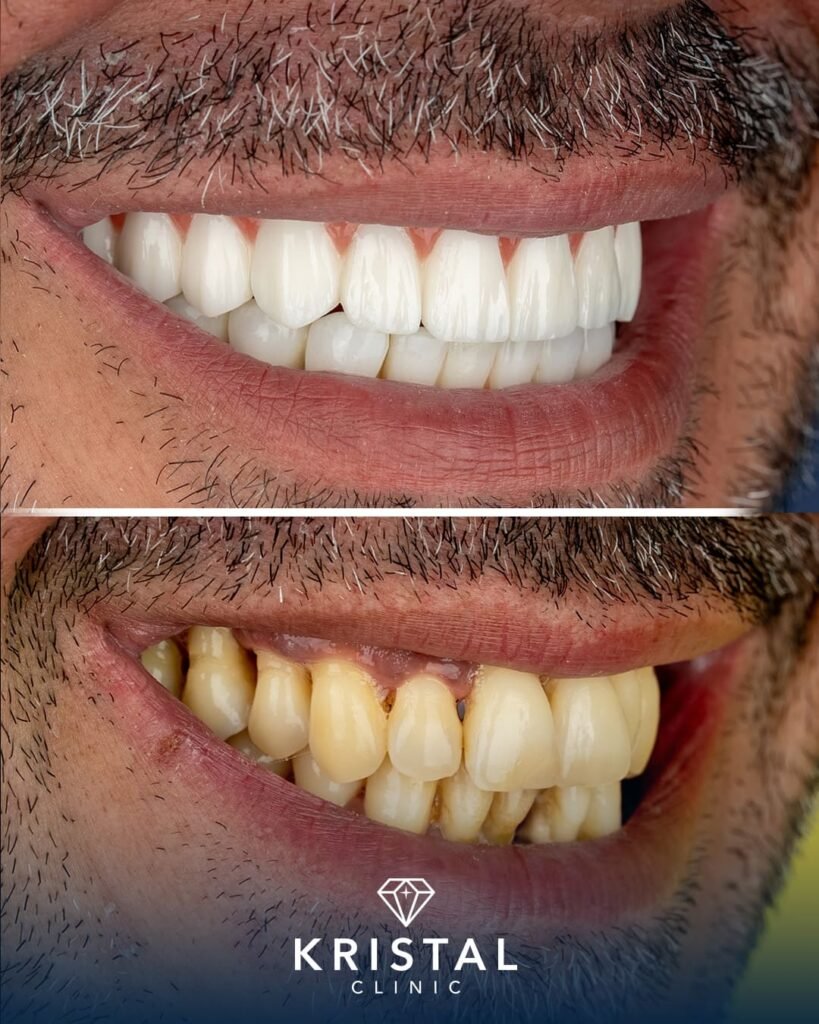
When considering what is the downside of all on four dental implants for daily life, diet is a major factor. You gain incredible bite force compared to dentures, but you lose the proprioception—the nerve feedback—that tells you how hard you’re biting. This means you must consciously avoid hard foods like ice, nuts, and hard candy to prevent mechanical failure. Reviewing real before and after All-on-4 dental implants results can help patients balance expectations between function and aesthetics.
Infection Detection: Recognizing Early Warning Signs
Patients often ask, “How do I know if I have an infection in my implant?” and “What are the early signs of implant infection?” The answers are found in subtle, persistent symptoms.
Key Early Indicators
The earliest signs of implant infection are often a persistent bad or metallic taste and localized redness of the gums that doesn’t resolve with brushing. Bleeding when gently probing around the implant is a red flag. More advanced signs include throbbing pain, visible pus, or swelling. Any mobility in the bridge is a dental emergency.
The Unspoken Realities: What No One Tells You
So, what does no one tell you about dental implants? The conversation often glosses over the long-term ownership model. The financial downside extends far beyond the initial quote and is best understood alongside a dedicated All-on-4 dental implants cost 2026 guide. For a specific look at the investment required for immediate function, review our breakdown of Same-Day All-on-4 costs.
If you are exploring international options to manage this investment without compromising on safety, we recommend reading our ranking of the best countries for All-on-4 implants to ensure you choose a destination with rigorous clinical standards.
The True Cost of Ownership
You are committing to a sophisticated medical device that requires scheduled maintenance. This includes professional cleanings 3-4 times a year (not twice), periodic screw replacements, and budgeting several thousand dollars every 5-10 years for significant repairs or bridge replacement. The “teeth” are a consumable component.
Furthermore, while implants preserve the bone where the screw is, the jawbone beneath the bridge span continues to slowly resorb. In my long-term follow-up patients, I often see subtle changes in facial support around the 15-year mark. This is a slow-motion side effect rarely discussed during initial consultations, but one we plan for
Prevention and Management: Mitigating the Risks
Understanding these all on 4 dental implants problems is the first step to preventing them. Success hinges on a rigorous, non-negotiable maintenance protocol.
The Prevention Protocol
Hygiene Mastery: A water flosser is essential to clean under the bridge. Brushing alone is insufficient.
- Professional Oversight: Commit to 3-4 professional maintenance visits per year for deep cleaning and screw torque checks.
- Protective Gear: A night guard is mandatory if you have any history of clenching or grinding (bruxism), the 1 cause of mechanical breakage.
- Dietary Discipline: Adopt a “no hard foods” rule to protect your investment.

All-on-4 dental implants solve the profound problem of toothlessness and are a remarkable advancement. For patients who prioritise aesthetics and function, a dedicated treatment overview can show how All-on-4 can get your smile back fast with a full-arch solution. However, portraying them as a perfect, maintenance-free solution does patients a disservice. The complications and risks are manageable but real. Informed patients who see this as a lifelong partnership in maintenance—not a one-time fix—experience the highest satisfaction and long-term success. The core problems are not about implant failure, but about prosthetic management and biological vigilance.
Want an honest second opinion?
Upload your dental records for a free, no-obligation risk assessment. We’ll review your specific case and tell you if All-on-4 is genuinely suitable for you — and if not, what alternatives might be better.
How do I know if I have an infection in my implant?
Signs of infection around a dental implant may include persistent swelling, redness, bleeding gums, pain when chewing, or a foul taste and odor. You might also notice gum recession around the implant area. These symptoms can be early indicators of all on 4 dental implants problems, especially if the infection threatens bone stability.
What is the biggest problem with dental implants?
The most significant issue can be implant failure due to poor osseointegration or peri-implantitis (gum infection around the implant). This may occur if bacteria reach the bone or if the implant cannot withstand chewing forces. These all on 4 dental implants risks increase in smokers, uncontrolled diabetics, and patients with poor oral hygiene.
What are the primary downsides of this procedure?
While All-on-4 provides immediate fixed teeth, a downside is that the entire bridge depends on just four implants. If one implant fails, the entire prosthesis may require removal or replacement. This is why understanding all on 4 dental implants complications is important when considering full-arch restoration.
What is the most common dental implant failure?
The leading cause of implant failure is inadequate osseointegration — when the implant does not fully fuse with the bone. Stress overload, infection, or bone deficiency can contribute to this issue. Poor bite force distribution may also lead to all on 4 dental implants breaking or loosening of the prosthesis over time.
What are the three major reasons for failure of implants?
The biggest contributors to implant failure are:
1️⃣ Bacterial infection (peri-implantitis)
2️⃣ Poor bone quantity or density
3️⃣ Excessive bite stress or bruxism
These issues can also contribute to all on 4 dental implants speech problems if soft tissues heal incorrectly or the temporary prosthesis is poorly adapted.