Medically reviewed by: Dr. Yusuf Sabir, Medipol University Faculty of Dentistry
Last updated: June 2026
Read time: 4–6 minutes
A good candidate for mini dental implants is typically an adult who:
Is missing one or more teeth or struggling with a loose denture.
Has sufficient jawbone to support a narrow-diameter implant.
Has no active periodontal (gum) disease.
Is healthy enough for a minor outpatient procedure.
Because mini implants are smaller than conventional implants, they can often be placed in patients with reduced bone volume who may not qualify for a standard implant without a bone graft.
If you’ve been told you don’t have enough bone for traditional implants, or you’re looking for a more secure solution for an unstable denture, mini dental implants may be worth exploring. They are typically between 1.8 mm and 3 mm in diameter, compared with approximately 3.25 mm to 6 mm for conventional implants, allowing them to fit in narrower areas of the jawbone while still supporting tooth replacement or denture stabilization.
This guide explains the real-world mini dental implant eligibility criteria, including bone density requirements, diabetes, autoimmune diseases, osteoporosis, smoking, age limits, and the factors that may disqualify someone from treatment.
If you’re new to the topic, start with our comprehensive guide to Mini Dental Implants Complete Clinical Guide, or learn more about modern Dental Implant Treatment Options available today.
Not sure whether you qualify? You can send us your panoramic X-ray or CBCT scan for a preliminary assessment and discuss your options directly with our clinical team via WhatsApp: Request a Free Mini Implant Assessment.
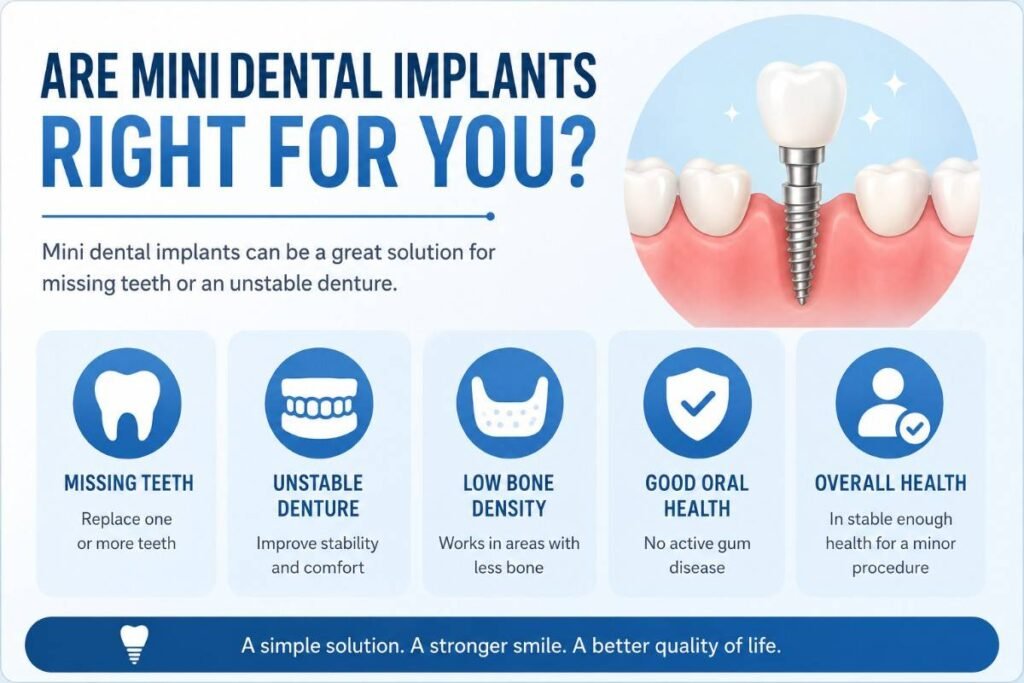
Table of Contents
ToggleWho Is a Good Candidate for Mini Dental Implants?
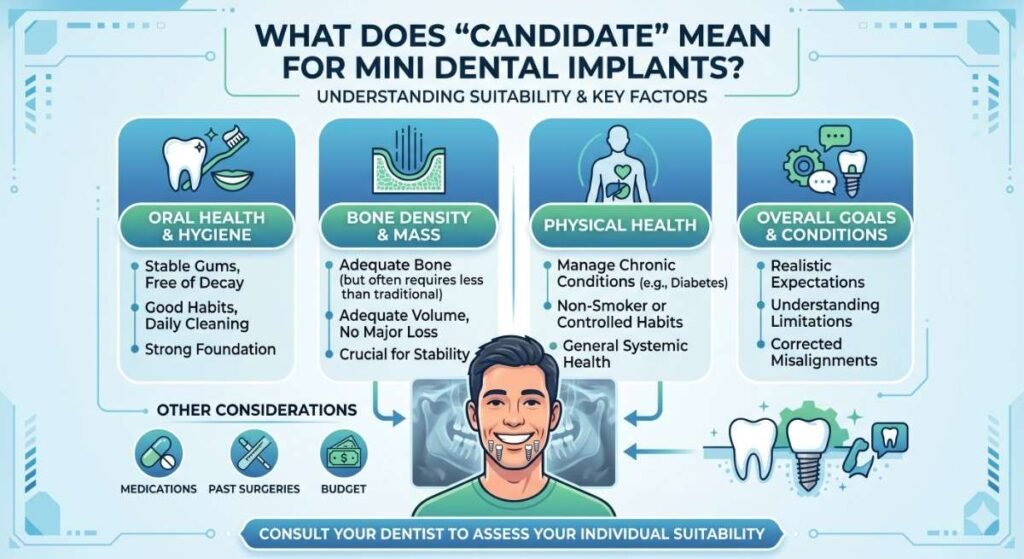
Candidacy for mini dental implants isn’t a simple pass-or-fail test. It’s a clinical judgment that weighs your jawbone anatomy, your general health, your oral health, and what you’re hoping to achieve — whether that’s stabilizing a denture, replacing a single tooth, or restoring a narrow gap where a standard implant wouldn’t fit comfortably.
Because mini implants are smaller in diameter, they can sometimes work in situations where a standard implant would first require a bone graft. That doesn’t mean they’re a fallback option for everyone with bone loss — it means they’re one additional tool that, in the right case, can avoid a more invasive step. Whether that applies to you depends on the factors below, and ultimately on an in-person or remote clinical evaluation. Understanding the surgical lifecycle before you begin can help set clear expectations; you can read about the baseline protocol in our guide on the mini dental implant procedure in 5 simple steps.
Mini Dental Implant Eligibility Criteria: Bone Density and Jawbone Volume
Bone density and bone volume matter because the implant needs enough surrounding bone to integrate securely — a process called osseointegration. The amount of bone required depends heavily on implant diameter, which is one of the main reasons mini implants exist.
Standard dental implants are generally around 3.25mm to 6mm in diameter and typically call for a wider band of healthy bone to support them.
Mini dental implants are narrower — often somewhere between about 1.8mm and 3mm — so they can frequently be placed in ridges that have narrowed over time, such as in patients who have worn dentures for many years and experienced gradual bone resorption.
Dentists commonly assess both the quantity of bone (how much width and height is available) and the quality of bone (how dense and well-structured it is), often using a classification system that ranges from dense bone to softer, more porous bone.
💡 Bone Loss and Alternative Surgical Paths
If traditional ridge limitations have left you searching for a less invasive path, comparing narrow-diameter fixtures against ridge augmentation can clarify your choices. To see how these clinical approaches compare regarding recovery timelines, costs, and structural success, read our guide on whether you can use mini dental implants vs. bone grafting in 2026 to completely bypass a secondary pre-treatment surgery.
Understanding Minimum Structural Dimensions
Although requirements vary by case, many mini implant candidates have approximately 4–5 mm of ridge width available, compared with the wider bone volume often needed for standard implants. Clinicians also evaluate vertical bone height, with around 10 mm often preferred in the lower jaw and approximately 13 mm in the upper jaw, depending on anatomical limitations and implant design. A CBCT scan is usually the most accurate way to determine whether these dimensions are available.
A panoramic X-ray gives an initial picture, while a CBCT (cone-beam CT) scan provides a 3D view that allows for more precise planning. If your bone volume has been a barrier to standard implants in the past, it’s worth having this imaging reviewed specifically with mini implants in mind, since the threshold is meaningfully lower than for standard-diameter implants. For a closer look at how mini and standard implants compare on bone requirements and biomechanics, see our Mini Dental Implants vs. Traditional Implants: Complete 2026 Clinical Comparison.
Mini Dental Implant Eligibility Criteria for Medical Conditions
Your overall health plays a significant role in how predictably any implant — mini or standard — heals and integrates. A few conditions come up often enough in patient questions that they deserve their own explanation.
Can Diabetics Get Mini Dental Implants?
Many people with diabetes can be candidates for mini dental implants, and candidacy generally comes down to how well the condition is controlled rather than the diagnosis itself. Many implant clinicians prefer to see HbA1c levels below approximately 7.5% before elective implant placement, although decisions are always individualized and made in consultation with the patient’s physician.
When blood sugar is well managed, healing and implant integration tend to proceed similarly to patients without diabetes. When diabetes is poorly controlled, healing can be slower and the risk of infection or integration problems tends to be higher, which is why many clinicians prefer to see stable blood sugar levels before proceeding. If you have diabetes, your dentist will likely want to coordinate with your physician to understand how well-controlled your condition currently is.
Can Patients With Autoimmune Diseases Get Mini Dental Implants?
Autoimmune conditions are not, on their own, an automatic disqualifier for mini dental implants — but they do warrant a closer look. What matters most is which condition you have, how active or well-controlled it currently is, and whether you take medications (such as certain immunosuppressants) that could affect healing or your body’s response to a minor surgical procedure.
Many patients with stable, well-managed autoimmune conditions go on to receive implants successfully. The practical step is making sure your dentist has a complete picture of your diagnosis, your current medications, and ideally some input from the physician managing your condition, so that any additional precautions can be planned in advance rather than discovered after treatment begins.
Can Patients With Osteoporosis or Bisphosphonate Medication Get Mini Dental Implants?
Lower bone density linked to osteoporosis is not automatically disqualifying for mini dental implants — in fact, because mini implants require less surrounding bone, they’re sometimes specifically considered for patients in this situation. The more important conversation is usually around medication: certain bone-affecting medications, including some bisphosphonates, can influence how bone responds to implant placement and healing. Sharing your full medication history, including anything taken for bone health in the past, helps your dental team plan appropriately.

Mini Dental Implant Eligibility Criteria: Gum Disease and Oral Health
Regardless of implant type, healthy gums are a starting point rather than a nice-to-have. Active, untreated gum disease (periodontal disease) increases the risk that an implant won’t integrate as expected, so most dental teams will want any active gum disease treated and stabilized first. Once your gums are healthy, and assuming you’re committed to the daily brushing, flossing, and follow-up visits that keep them that way, gum health generally supports — rather than limits — mini implant candidacy.
Is There an Age Limit for Mini Dental Implants?
There’s no upper age limit for mini dental implants based on age alone. Clinical literature on implant therapy in older adults generally finds that age by itself isn’t a reason to rule out treatment — what matters more is overall health, healing capacity, and bone quality, which vary from person to person regardless of age. Many patients in their 70s, 80s, and beyond have been treated successfully, often benefiting from the comparatively short, minimally invasive nature of mini implant placement. On the other end of the age range, implants are generally not placed until the jaw has finished growing, which is typically around the late teens. This is a developmental consideration rather than a strict cutoff, and your dentist can advise based on your individual situation. If you’re specifically researching candidacy as an older adult, our guide on mini dental implants for dentures—are they worth it in 2026? looks at this from a value and long-term-fit perspective.
Can Smokers Get Mini Dental Implants?
Smoking is associated with slower healing and a higher risk of complications around dental implants, including mini implants. Tobacco use may reduce blood flow to healing tissues and can negatively affect osseointegration, the biological process that secures the implant within the jawbone.
This doesn’t automatically rule someone out, but it’s a factor your dentist will want to discuss honestly — including whether reducing or pausing smoking around the time of the procedure could improve your outcome. If you smoke and are considering mini implants, raising this proactively during your consultation allows your dental team to plan with it in mind, rather than treating it as an afterthought.
Mini Dental Implant Candidate Checklist
The questions below won’t replace a clinical evaluation, but they can help you organize your thoughts before a consultation and make that conversation more productive.
- Are you missing one or more teeth, or do you have a denture that no longer fits securely?
- Has a dentist previously told you that you don’t have enough bone for a standard implant?
- If you have a chronic health condition (such as diabetes, an autoimmune disease, or osteoporosis), would you describe it as currently well-managed?
- Do you notice any signs of active gum problems, such as bleeding, swelling, or persistent bad breath?
- Do you currently smoke, and would you be open to discussing this with your dentist as part of treatment planning?
- Are you an adult whose jaw has finished growing (generally late teens or older)?
If most of your answers point toward “yes, this seems to fit me,” mini dental implants may be worth discussing with a dentist. If several answers raise questions — particularly around active gum disease or an unmanaged health condition — those are exactly the points a clinical evaluation is designed to work through with you.
Suitability Profile: Factors That Support or Complicate Candidacy
| Factor | Generally Supports Candidacy | May Need Further Evaluation First |
|---|---|---|
| Bone volume | Narrowed ridge (e.g., from long-term denture wear), insufficient width for a standard implant | Severe bone loss that may still be limiting even for a narrower implant |
| Blood sugar / diabetes | Well-controlled blood sugar | Poorly controlled diabetes |
| Autoimmune conditions | Stable, well-managed condition with dentist aware of medications | Active flare or medications affecting healing, not yet discussed with dentist |
| Bone health / osteoporosis | Reduced bone density managed without high-risk bone medications | Use of certain bone-affecting medications not yet reviewed |
| Gum health | Healthy or previously treated gums | Active, untreated gum disease |
| Age | Any adult age, with completed jaw growth | Jaw still developing (typically under late teens) |
| Smoking | Non-smoker, or willing to discuss with dentist | Heavy smoking not yet discussed in treatment planning |
| Restoration goal | Denture stabilization, single tooth, or narrow-space replacement | Replacing a high-bite-force molar as the sole long-term solution |
What Disqualifies Someone From Getting Mini Dental Implants?
For some patients, mini dental implants may not be the most suitable option — at least not without addressing other factors first. This generally includes patients with active, untreated periodontal disease, those currently on certain high-dose bone-affecting medications that haven’t yet been reviewed with a dentist, and cases where the primary goal is replacing a heavy-bite-force molar with the most load-bearing option available. When assessing full-arch options for denture wearers, identifying these limiting architectural elements is a core focus inside our comprehensive mini implant-supported dentures 2026 clinical guide. None of these situations are necessarily permanent — gum disease can often be treated, and medication timing can sometimes be coordinated with a physician. For a fuller picture of where mini implants have real limitations, see our guide on the [disadvantages of mini dental implants].
Can Mini Dental Implants Be Loaded Immediately?
In selected cases, mini dental implants can often support a temporary restoration immediately after placement. Unlike conventional implant protocols that may require a healing period before loading, mini implants frequently achieve strong primary stability because their narrow diameter allows engagement of dense cortical bone during insertion.
This immediate stability can make mini implants particularly useful for denture stabilization, allowing some patients to experience improved function and retention soon after treatment. However, immediate loading is not appropriate for every case. Factors such as bone quality, implant position, insertion torque, bite forces, and overall oral health must all be evaluated before a dentist determines whether an implant can be loaded immediately.
While immediate loading can be a significant advantage, long-term success still depends on successful osseointegration — the biological process in which bone bonds to the implant surface over time. For this reason, treatment planning is always individualized based on the patient’s anatomy, medical history, and restoration goals.
How Dentists Assess Who Qualifies for Mini Dental Implants
In practice, candidacy is confirmed through a combination of your medical history, an oral examination, and imaging — usually a panoramic X-ray and, where more precision is needed, a CBCT scan that shows bone width, height, and density in three dimensions.
For patients who aren’t local, many clinics — including ours in Istanbul, Türkiye — offer a remote review process: you share an existing panoramic X-ray or CBCT scan along with some background on your dental and medical history, and a clinician can give you an initial sense of whether mini implants are likely to be a fit before you travel for an in-person evaluation. This isn’t a substitute for an in-person exam, but it can help you understand your options before committing to next steps. If you’d like to start that conversation, you can [request a remote review of your scan and history] with our clinical team.
Frequently Asked Questions
Who is a good candidate for mini dental implants?
Generally, adults who are missing one or more teeth or have an unstable denture, have reduced jawbone width or height, have healthy or treated gums, and are in stable enough overall health for a minor procedure. A clinical evaluation, including imaging, confirms candidacy on an individual basis.
What age should you not get dental implants?
There’s no upper age limit based on age alone — many older adults are successfully treated. The main lower-end consideration is that implants are generally not placed until the jaw has finished growing, typically by the late teens.
How much bone density is actually needed for mini implants?
Mini implants require less surrounding bone than standard implants because of their narrower diameter (roughly 1.8–3mm versus 3.25–6mm for standard implants). The exact amount needed for your case depends on imaging — a CBCT scan gives the clearest picture of your available bone width, height, and density.
Can patients with autoimmune diseases get mini dental implants?
Often, yes — particularly when the condition is stable and well-managed. Candidacy depends on the specific condition, how active it currently is, and any medications that could affect healing, which is why a thorough medical history review is part of the evaluation.
Can diabetics get mini dental implants?
Many people with well-controlled diabetes are candidates for mini dental implants. Poorly controlled diabetes can affect healing, so stable blood sugar levels are generally an important part of the evaluation.
Can smokers get mini dental implants?
Smoking increases the risk of healing complications and isn’t necessarily an absolute disqualifier, but it’s an important factor to discuss openly with your dentist as part of treatment planning.
Who should avoid dental implants entirely?
This depends on individual circumstances rather than a fixed list, but it generally includes patients with active untreated gum disease, certain unmanaged medical conditions, or specific medication situations that haven’t yet been reviewed by a dentist. Many of these are addressed before treatment rather than being permanent. For a broader look at situations where mini implants specifically may not be the right fit, see our [disadvantages of mini dental implants] guide.
This article is provided for general educational purposes and does not constitute medical or dental advice, diagnosis, or treatment recommendations. Mini dental implant candidacy depends on individual anatomy, medical history, and oral health, and can only be confirmed through a clinical evaluation, including appropriate imaging, by a qualified dental professional. If you have a medical condition, always discuss treatment planning with both your dentist and your treating physician.