
Medically Reviewed by Dr. Anas Zemzemi
Specialist in Oral Surgery & Implantology
Updated June 2026
Read time : 3—5 min
Written by : Kristal Clinic Editorial Team
A mini dental implant procedure is a minimally invasive treatment used to replace missing teeth or stabilize dental restorations using narrow-diameter titanium implants. Unlike conventional dental implants, , many cases can be completed using a flapless approach with minimal tissue disruption and faster recovery.
This step-by-step guide explains exactly what happens during a mini implant procedure, from CBCT planning and local anesthesia to implant placement, primary stability assessment, immediate loading protocols, and long-term healing. Understanding each stage of treatment helps patients know what to expect before, during, and after surgery.
If you are looking for a comprehensive overview of indications, benefits, and overall scope, explore our Mini Dental Implants Complete Clinical Guide 2026.
📞 Need quick answers about your smile? You can text our medical team directly to get a free quote on WhatsApp and find out if mini dental implants are right for your specific case.
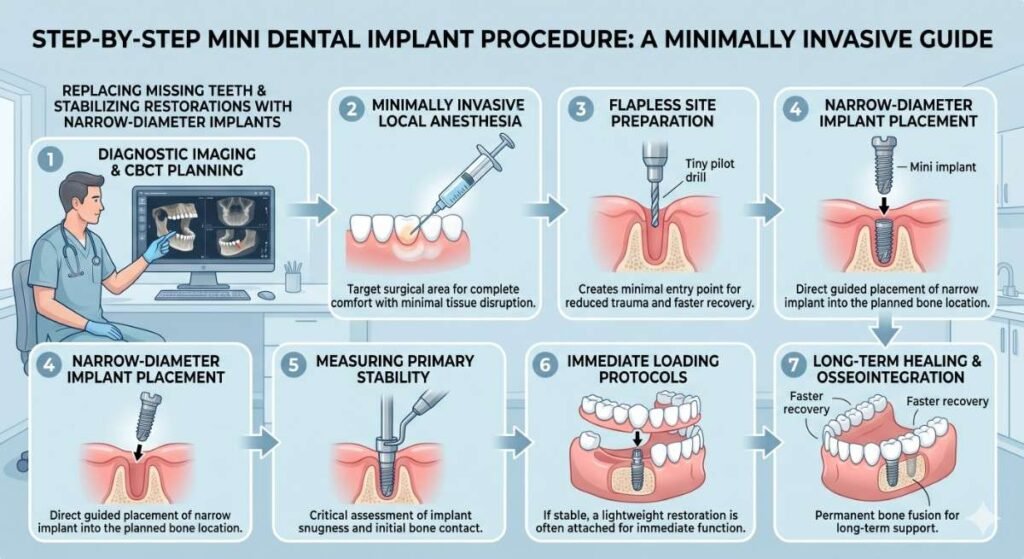
Table of Contents
ToggleWhat Is a Mini Dental Implant Procedure?
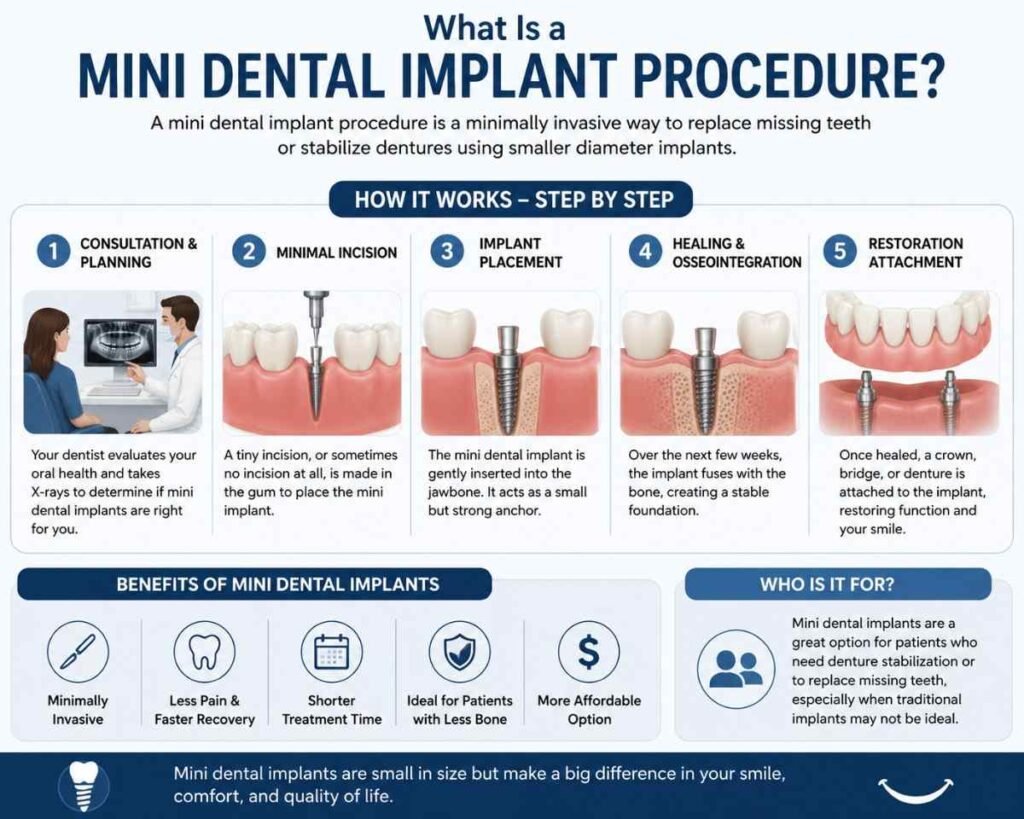
A mini dental implant procedure is a minimally invasive treatment that uses narrow-diameter titanium implants to replace missing teeth or support dental restorations. The mini implant procedure typically involves digital treatment planning, local anesthesia, implant placement, stability assessment, and a healing phase that allows the implant to integrate with the surrounding bone.
Compared with conventional protocols, mini implants are smaller in diameter and often require less surgical preparation.Depending on bone anatomy and treatment goals, some patients may receive a temporary restoration shortly after implant placement as part of the same day mini dental implants process. Patients comparing treatment abroad can also review our guide to mini dental implants in Türkiye to understand local procedure expectations, treatment planning, and international patient considerations.
Patients seeking a broader understanding of mini implant treatment options can explore the Mini Dental Implants Complete Clinical Guide for a comprehensive overview of indications, benefits, and limitations.
Understanding how the mini dental implant treatment process works helps patients make informed decisions and prepare for treatment, recovery, and long-term maintenance.
Who Is a Candidate for a Mini Implant Procedure?
To find out if your specific jawbone anatomy and medical history match these requirements, review our master guide on the who is a candidate for mini dental implants eligibility criteria 2026.
Ideal Candidates
Patients who may benefit from a mini dental implant procedure often include:
- Individuals missing one or several teeth
- Patients with limited bone width
- Patients seeking a minimally invasive treatment approach
- Individuals with healthy gums and good oral hygiene
- Patients looking for a shorter treatment process when clinically appropriate
Borderline Candidates
Additional evaluation may be required for:
- Smokers
- Patients with controlled diabetes
- Individuals with a history of periodontal disease
- Patients taking medications that influence bone metabolism
Suitability Matrix
Patient Profile | Suitability |
Single Missing Tooth | Excellent |
Limited Bone Width | Excellent |
Adequate Bone Density | Excellent |
Controlled Diabetes | Often Suitable |
Smoker | Case Dependent |
Active Gum Disease | Requires Treatment First |
Severe Bone Loss | Additional Assessment Required |
A personalised assessment remains essential because every patient’s anatomy and medical history are different.
Preserve your spot with our professional dental treatment and get a free quote regarding your case via WhatsApp.
Pre-Procedure Evaluation and Digital Planning
Successful narrow diameter implant placement begins with proper digital planning and bone analysis. Modern treatment planning includes a comprehensive examination, medical history review, and advanced imaging to evaluate bone anatomy and identify important anatomical structures.
Clinical Examination
The initial consultation for a mini dental implant procedure may include:
- Evaluation of missing teeth
- Gum health assessment
- Bite analysis
- Review of previous dental work
- Medical history review
CBCT Planning for Mini Dental Implant Placement
Cone Beam Computed Tomography (CBCT) provides three-dimensional imaging that helps clinicians plan mini implant placement procedure with precision. This imaging evaluates:
- Bone width and height
- Bone density
- Nerve pathways
- Adjacent tooth roots
- Available implant positioning
This information allows for more accurate treatment planning and helps reduce surgical risks during the mini dental implant procedure.
Primary Stability Assessment Before Mini Implant Placement
Before proceeding with narrow diameter implant placement, clinicians evaluate three core factors:
- Available Bone Volume
- Bone Density Characteristics
- Expected Functional Loading
These factors help determine whether immediate restoration is possible and whether the implant is likely to achieve adequate primary stability.

Step-by-Step Mini Dental Implant Procedure
Patients often ask what happens during mini implant surgery. While treatment details vary, the mini dental implant placement steps generally follow a predictable sequence.
Step 1: Local Anesthesia
The mini dental implant procedure typically begins with local anesthesia to ensure patient comfort. Most patients report feeling pressure and vibration rather than pain during treatment.
Flapless Surgical Protocol & Site Preparation
Once profound local anesthesia is established, the clinician initiates site preparation. Where traditional root-form implants require cutting a surgical flap to expose the underlying jawbone, mini implant mechanics frequently allow for a flapless placement technique.
Using a precise mucosal tissue punch, a tiny entry point (matching the narrow diameter of the intended fixture) is made directly through the gum tissue. A single, low-speed pilot drill creates a minor entry pathway into the bone. Because the underlying periosteum (the tissue covering bone that contains blood vessels and nerves) is left entirely undisturbed, post-operative swelling, bleeding, and recovery times are reduced by more than half compared to conventional open-flap surgeries.
MDI Implant Insertion Steps and Implant Placement
The mini implant placement procedure is designed to achieve stability while minimising surgical trauma. The implant is carefully inserted into the prepared site, engaging the surrounding bone while maintaining proper alignment and positioning. Modern MDI implant insertion steps often utilize a self-tapping design manufactured from Grade 5 titanium alloy (Ti-6Al-4V). During these mini dental implants placement steps, clinicians aim to maximize cortical bone engagement while preserving surrounding crestal bone and minimizing surgical trauma. Proper positioning helps improve bone-to-implant contact and supports predictable healing. During mini implant insertion steps, clinicians monitor depth, angulation, and insertion characteristics to ensure optimal results.
Insertion Torque & Primary Stability Assessment
Immediate mechanical stability—known as primary stability—is calculated the moment the implant is fully seated. Unlike traditional implants that require weeks of quiet healing, mini implants rely on a mechanical “wedge effect” within the dense outer cortical bone.
To objectively determine if an implant can withstand immediate functional weight, clinicians measure the final insertion torque using a calibrated manual wrench or a digital handpiece.
Same-Day Loading Protocols
For a patient to qualify for the same-day mini dental implants process (immediate loading of a temporary crown or overdenture stabilization housing), the clinical site must meet strict biomechanical criteria:
Minimum Insertion Torque: A threshold of 30 to 35 Ncm (Newton-centimeters) must be reached during the final turns of insertion.
Anatomical Selection: Highly favorable in the dense bone of the lower anterior jaw (mandibular symphysis) or for non-functional single missing teeth like upper lateral incisors.
Exclusion Factors: If torque falls below 30 Ncm, or if the patient presents severe nocturnal bruxism (teeth grinding), immediate loading is bypassed in favor of a traditional 3-to-4 month delayed healing phase to prevent micro-movement and early fixture failure.

How Long Does a Mini Dental Implant Procedure Take?
The mini implant procedure itself is often completed relatively quickly, although total treatment timelines vary.
Stage | Typical Timeline |
Consultation | 30–60 Minutes |
CBCT Evaluation | Same Day |
Treatment Planning | Same Day or Shortly After |
Implant Placement | Often Less Than One Hour |
Early Healing | First Week |
Functional Adaptation | Several Weeks |
Osseointegration | Several Months |
While the surgical appointment may be brief, biological healing continues for several months as the implant integrates with surrounding bone.
Does the Procedure Hurt?
Most patients experience minimal discomfort during mini dental implant surgery because local anesthesia is used throughout. During surgery, patients typically notice pressure, mild vibration, and sensations of movement.
After mini implant surgery, some temporary symptoms may occur:
- Mild soreness
- Swelling
- Tenderness around the implant site
These effects often improve within the first few days. Many patients report less discomfort than they expected before undergoing the mini dental implant procedure.
Recovery After a Mini Dental Implant Procedure
Recovery following mini dental implant surgery is generally straightforward when post-operative instructions are followed carefully. Patients should understand that mini implant surgery recovery timelines vary depending on bone quality, overall health, and treatment complexity.
First 24 Hours of Mini Dental Implant Surgery Recovery
Patients are commonly advised to:
- Rest as needed
- Avoid smoking
- Avoid vigorous rinsing
- Follow prescribed post-operative instructions
- Choose softer foods
Week One Recovery After Mini Implant Surgery
During the first week of mini implant surgery recovery, patients may notice reduced swelling, improved comfort, and a gradual return to normal activities. Follow-up appointments may be scheduled to monitor healing.
Soft Tissue Healing During the First Month
Most patients continue adapting to the implant during the first month. Soft tissue healing progresses while the surrounding bone begins biological remodelling.
Osseointegration and Long-Term Bone-to-Implant Contact
Although patients often feel comfortable relatively quickly after mini dental implant surgery, osseointegration continues beneath the surface. During this biological process, surrounding bone cells establish direct bone-to-implant contact, creating long-term stability. Healthy peri-implant tissue, controlled functional loading, and consistent maintenance appointments all contribute to long-term success. This process involves direct biological integration between the implant and surrounding bone and may continue for several months depending on individual healing characteristics.

Mini Dental Implant Procedure Risks and Complications
Like any surgical procedure, the mini dental implant procedure carries potential risks. Possible complications may include:
- Infection
- Delayed healing
- Swelling or bleeding
- Implant mobility
- Temporary discomfort
- Soft tissue irritation
The likelihood of complications can be reduced through proper planning, careful surgical technique, and adherence to post-operative instructions. Patients should report unusual symptoms to their treating clinician promptly.
Frequently Asked Questions
What insertion torque is required for mini dental implants?
During a mini dental implant procedure, clinicians often evaluate insertion torque measured in Newton centimeters (30—35Ncm). Adequate torque values indicate strong primary stability, which may support immediate restoration protocols in appropriately selected patients. Required torque levels vary depending on implant design, bone density, and treatment objectives.
What happens during a mini implant procedure?
The mini implant procedure involves local anesthesia, site preparation, narrow diameter implant placement, a primary stability assessment, and — where appropriate — attachment of a temporary restoration. The entire surgical appointment is often completed in less than one hour.
How long does a mini dental implant procedure take?
Many procedures can be completed in less than one hour, although treatment times vary depending on the number of implants and case complexity. Biological osseointegration continues for several months after the surgical appointment.
What are the main mini implant insertion steps?
The core mini implant insertion steps are: administering local anesthesia, preparing the implant site with minimal tissue disruption, placing the narrow-diameter titanium implant, assessing primary stability, and determining whether immediate restoration is appropriate for the individual case.
Can mini implants be placed in one visit?
Yes. In many cases, mini implant placement can be completed during a single appointment. Treatment planning and follow-up care may require additional visits.
Do mini implants require stitches?
Not always. Some minimally invasive mini implant procedures may not require sutures, although treatment approaches vary depending on the individual case.
Conclusion
A mini dental implant procedure is a predictable treatment process that includes planning, placement, healing, and long-term maintenance. The mini implant procedure uses narrow-diameter titanium implants to replace missing teeth or support restorations in a minimally invasive way, with a surgical appointment that is often completed in less than one hour.
Understanding each stage of the mini dental implant treatment process — from digital planning and narrow diameter implant placement through to mini implant surgery recovery — helps patients make informed decisions before treatment.
Because every patient presents unique anatomical and clinical factors, a comprehensive examination and CBCT evaluation are important steps in determining whether the mini dental implant procedure is the right treatment option.
If you already have a panoramic X-ray or CBCT scan, a professional review can help determine whether a mini implant procedure may be suitable for your individual situation.
Scientific References
Flanagan D. Mini dental implants supporting crowns and overdentures. Compendium of Continuing Education in Dentistry. 2005;26(9):593–600.
Bulard RA, Vance JB. Multi-clinic evaluation using mini-dental implants for long-term denture stabilization: A preliminary biometric evaluation. Compendium of Continuing Education in Dentistry. 2005;26(12):892–897.
Griffitts TM, Collins CP, Collins PC. Mini dental implants: An adjunct for retention, stability, and comfort for the edentulous patient. Oral Surgery, Oral Medicine, Oral Pathology, Oral Radiology, and Endodontology. 2005;100(5):e81–e84.
Sohrabi K, Mushantat A, Esfandiari S, Feine J. How successful are small-diameter implants? A literature review. Clinical Oral Implants Research. 2012;23(5):515–525.
Klein MO, Schiegnitz E, Al-Nawas B. Systematic review on success of narrow-diameter dental implants. International Journal of Oral and Maxillofacial Implants. 2014;29(Suppl):43–54.
Bidra AS, Almas K. Mini implants for definitive prosthodontic treatment: A systematic review. Journal of Prosthetic Dentistry. 2013;109(3):156–164.
Schiegnitz E, Al-Nawas B. Narrow-diameter implants: A systematic review and meta-analysis. Clinical Oral Implants Research. 2018;29(Suppl 16):21–40.
Javed F, Romanos GE. The role of primary stability for successful immediate loading of dental implants. Journal of Dentistry. 2010;38(8):612–620.
Sennerby L, Meredith N. Implant stability measurements using resonance frequency analysis: Biological and biomechanical aspects and clinical implications. Periodontology 2000. 2008;47:51–66.
Esposito M, Grusovin MG, Willings M, Coulthard P, Worthington HV. Interventions for replacing missing teeth: Different times for loading dental implants. Cochrane Database of Systematic Reviews. 2007;(2):CD003878.
Degidi M, Piattelli A, Carinci F. Immediate loaded dental implants: Comparison between fixtures inserted in post-extractive and healed bone sites. Journal of Craniofacial Surgery. 2007;18(4):965–971.
Srinivasan M, Makarov NA, Herrmann FR, Müller F. Implant survival in elderly patients receiving narrow-diameter implants for overdenture stabilization: A systematic review. Clinical Oral Investigations. 2014;18(7):1793–1804.
Elsyad MA, Gebreel AA, Fouad MM, Elshoukouki AH. The clinical and radiographic outcome of immediately loaded mini implants supporting mandibular overdentures. International Journal of Oral and Maxillofacial Implants. 2011;26(5):1063–1071.
Lemos CAA, Verri FR, Batista VES, et al. Complete overdentures retained by mini implants: A systematic review. Journal of Dentistry. 2017;57:4–13.
Al-Johany SS, Al Amri MD, Alsaeed S, Alalola B. Dental implant length and diameter: A proposed classification scheme. Journal of Prosthodontics. 2017;26(3):252–260.