Medically Reviewed : by Dr.Anas Zemzemi
Specialist in Oral Surgery & Implantology
Updated June 2026
Written by Kristal Clinic Editorial Team
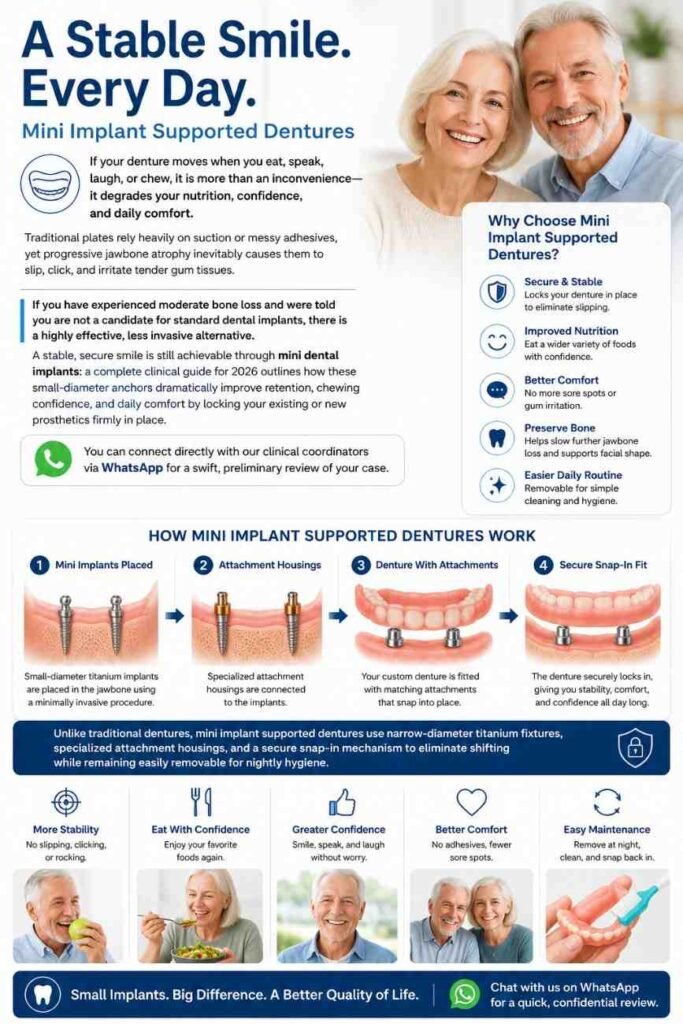
If your denture moves when you eat, speak, laugh, or chew, it is more than an inconvenience—it degrades your nutrition, confidence, and daily comfort. Traditional plates rely heavily on suction or messy adhesives, yet progressive jawbone atrophy inevitably causes them to slip, click, and irritate tender gum tissues.
If you have experienced moderate bone loss and were told you are not a candidate for standard dental implants, there is a highly effective, less invasive alternative. A stable, secure smile is still achievable through mini dental implants: a complete clinical guide for 2026 outlines how these small-diameter anchors dramatically improve retention, chewing confidence, and daily comfort by locking your existing or new prosthetics firmly in place , you can connect directly with our clinical coordinators via WhatsApp for a swift, preliminary review of your case.
Unlike traditional dentures, mini implant supported dentures use narrow-diameter titanium fixtures, specialized attachment housings, and a secure snap-in mechanism to eliminate shifting while remaining easily removable for nightly hygiene.
Table of Contents
ToggleDefinition Box
Mini implant supported dentures are removable dentures stabilized by narrow-diameter titanium implants placed into the jawbone to improve retention, chewing ability, comfort, and confidence.
What Are Mini Implants for Dentures?
Mini implants for dentures are narrow dental implants used to stabilize a removable denture.
In this treatment, the denture connects to titanium mini implants using a ball-and-socket attachment mechanism or an O-ring attachment denture system.
This creates an implant-retained denture that feels more stable than a conventional removable denture.
How Do Mini Dental Implant Supported Dentures Work?
Mini dental implant supported dentures work by connecting a removable denture to implants placed in the jawbone.
After placement, the bone gradually bonds to the implant surface through osseointegration.
Many Mini Dental Implants (MDIs) feature a small-diameter, self-tapping design that mechanically engages dense cortical bone during placement. This engagement can help generate high insertion torque, which is one reason immediate loading may be considered for appropriately selected patients.
Once healing has progressed, the denture snaps onto the implants using internal retention components.
This helps improve lower denture stabilization, especially for patients whose lower denture moves during eating or speech.
Because loading and bone integration parameters are strictly case-dependent, a personalized diagnostic review is required to determine your eligibility. You can instantly request a free digital consultation via WhatsApp to find out if your bone profile qualifies for immediate mechanical stabilization.

Why Mini Dental Implants Are Structurally Different
One of the key differences between Mini Dental Implants (MDIs) and standard implant systems is their design.
Most modern mini implants use a monolithic one-piece structure manufactured from high-strength Grade 5 Titanium Alloy (Ti-6Al-4V).
This design may reduce complications linked to two-piece implant systems, such as micro-gap formation or screw loosening.
However, the trade-off is surgical precision.
Because the abutment is built into the implant body, post-placement correction is limited. For predictable attachment function, many protocols aim to keep implant divergence within approximately 15 degrees to reduce premature wear of the denture housings and O-rings.
Mini Implant Dentures for Bone Loss
Mini implant dentures for bone loss may be considered when a patient has reduced jawbone width but still has enough bone quality for implant stability.
Mini implants commonly range from approximately 1.8 mm to 2.5 mm in diameter, although some systems may extend up to around 3.0 mm.
In selected cases, they may be considered in narrow alveolar ridges measuring approximately 4–5 mm in buccolingual width.
By comparison, many standard implant systems require greater ridge width or additional augmentation planning.
Bone width alone is not enough. Clinicians also evaluate bone density, vertical bone height, jaw atrophy, bite forces, and anatomical limitations using CBCT imaging.
Can you completely bypass a bone graft using mini implants? While mini implants excel in narrow ridges, choosing between them and a traditional graft involves weighing surgery complexity, healing times, and long-term stability. For a direct head-to-head comparison, read our clinical breakdown: Mini Dental Implants vs. Bone Grafting: Which Option is Better in 2026?
Mini Implant vs Standard Implant Dentures
The comparison between mini implant vs standard implant dentures should focus on anatomy, stability goals, and functional requirements.
| Factor | Mini Implant Dentures | Standard Implant Dentures |
|---|---|---|
| Implant diameter | Smaller, often 1.8–3.0 mm | Wider |
| Ridge width need | May suit narrower ridges | Often needs more width |
| Surgical correction | Limited after placement | More restorative flexibility |
| Common use | Denture stabilization | Broader implant prosthetics |
| Maintenance | O-rings and housings may need service | Depends on attachment design |
While mini implants are excellent for stabilizing loose plates in narrow bone, standard implants offer greater multi-unit restorative flexibility. To see exactly how these technical differences dictate your surgical timeline and long-term success, read our deep-dive analysis on mini dental implants: a complete clinical guide for 2026.
Mandibular vs Maxillary Implant-Retained Dentures
Upper and lower jaws do not behave the same.
| Clinical Factor | Lower Jaw / Mandible | Upper Jaw / Maxilla |
| Common implant count | Often 4 mini implants | Often 4–6 mini implants |
| Bone pattern | Denser cortical bone | Softer trabecular bone |
| Denture stability | Often more predictable | More anatomy-dependent |
| Palate design | Often palate-free | Palate coverage may still be needed |
| Treatment complexity | Common for loose lower dentures | Requires careful planning |
Lower denture stabilization is one of the most common uses of mini implant supported dentures because the lower jaw often provides less natural suction than the upper jaw.

Do Implant-Supported Dentures Have a Palate?
Do implant-supported dentures have a palate? Not always.
Some upper implant dentures may qualify for a palate-free denture design, but this depends on implant number, implant distribution, bone support, and denture stability.
Lower dentures do not cover the palate because the palate is part of the upper jaw.
Can Implant Supported Dentures Be Removed?
Yes. Can implant supported dentures be removed? In most mini implant cases, yes.
Mini implant dentures are usually removable overdenture systems.
Patients typically remove them for daily cleaning, denture care, and professional maintenance.
This is different from fixed implant restorations, which are not removed by the patient.
Mini Implants for Dentures Pros and Cons
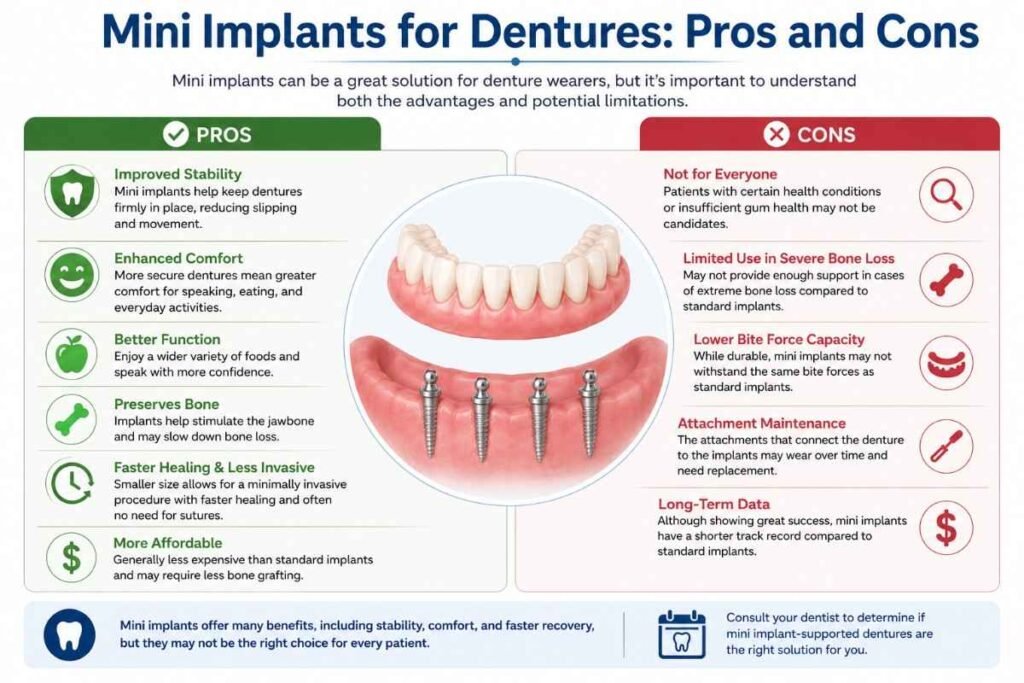
Understanding mini implants for dentures pros and cons helps patients make a more realistic decision.
Pros
- Better retention than loose conventional dentures
- Reduced denture movement
- May reduce reliance on a denture adhesive alternative
- Often useful for lower denture stabilization
- May help selected bone-loss patients
Cons
- Not suitable for every patient
- O-rings and housings require maintenance
- Severe bruxism may increase risk
- Existing dentures may need reinforcement or replacement
- Long-term success depends on oral hygiene and follow-up care
Are Mini Implants Strong Enough for Full Dentures?
Mini implants may be strong enough to stabilize full removable dentures in selected patients.
The answer depends on implant number, bone quality, bite force, jaw anatomy, and prosthetic design.
Patients with severe clenching or heavy lateral forces may need additional evaluation because small diameter implants have less surface area than wider implants.
Mini Implant Supported Dentures Recovery Time
Mini implant supported dentures recovery time varies by patient.
Recovery depends on bone quality, implant stability, oral health, and the complexity of the case.
| Stage | Purpose |
| First days | Soft tissue healing |
| Early weeks | Denture adaptation |
| Following months | Continued osseointegration |
| Long term | Maintenance and monitoring |
Some patients may resume gentle function quickly, but the exact timeline should always follow the clinician’s instructions.

How Long Do Mini Implants for Dentures Last?
How long do mini implants for dentures last? Many can function for years when properly planned, placed, and maintained. For a thorough review of structural survival rates and medical data over a multi-year baseline, explore our peer-reviewed evaluation of how long do mini implants last and what the evidence shows.
Longevity depends on:
- Bone density
- Oral hygiene
- Smoking status
- Medical conditions
- Bite forces
- O-ring and attachment maintenance
- Regular follow-up visits
No ethical clinic should guarantee a fixed lifespan because outcomes vary between patients.
Long-Term Maintenance for O-Ring Attachment Dentures
Maintenance is one of the most important realities of implant-stabilized dentures.
O-Ring Wear
Routine maintenance helps preserve retention and comfort.
Patients should also avoid highly abrasive conventional toothpastes when cleaning removable overdentures. Excessively abrasive products may create microscopic scratches within the acrylic surface. These micro-irregularities can accumulate plaque and bacteria more easily, contribute to staining, and may accelerate wear of attachment housings over time.
Clinicians often recommend denture-specific cleaning products designed for removable prostheses.
In an O-ring attachment denture, elastomeric inserts gradually lose retention because of friction, chewing forces, and repeated insertion and removal.
Many patients need replacement inserts approximately every 6–12 months, although timing varies.
Denture Base Reinforcement
When an existing acrylic denture is converted into an implant-retained denture, space must be created for metal housings.
This can weaken the acrylic base.
For durability, clinicians may recommend a new overdenture with a cobalt-chromium cast metal reinforcement framework embedded inside the acrylic to reduce midline fracture risk.
Ball Abutment Wear
A ball abutment attachment may also wear over time because of repeated friction.
Routine maintenance helps preserve retention and comfort.

Am I a Candidate for Mini Implant Supported Dentures?
Am I a candidate for mini implant supported dentures? You may be considered if you have loose dentures, adequate bone quality, healthy oral tissues, and realistic expectations. To map out how your physical anatomy and general health history align with these parameters, read through our who is a candidate for mini dental implants eligibility criteria 2026 breakdown.
You may need additional evaluation if you have:
- Severe bruxism or clenching
- Poorly controlled diabetes
- Active gum disease
- Heavy smoking habits
- Medications affecting bone metabolism
- Severe jaw atrophy
- Poor denture hygiene
A clinical exam and CBCT scan are needed before confirming suitability.
Mini Implant Dentures vs Implant Supported Bridges
Although both treatments improve stability and chewing ability, they are designed for different clinical goals.
| Feature | Mini Implant Dentures | Implant Supported Bridges |
|---|---|---|
| Removable | Yes | No |
| Daily Cleaning | Remove nightly | Clean like natural teeth |
| Bone Requirement | Lower | Higher |
| Surgical Complexity | Lower | Higher |
| Cost | Lower | Higher |
| Number of Implants | Usually 4–6 | Usually 4–8 |
| Treatment Time | Faster | Longer |
| Feel Like Natural Teeth | Good | Excellent |
Mini implant dentures are often recommended for patients seeking a more affordable and minimally invasive solution.
Implant supported bridges are typically chosen by patients who want a fixed, non-removable restoration that closely mimics natural teeth.
The best choice depends on jawbone volume, oral health, budget, and long-term treatment goals.
Do Implant-Supported Dentures Hurt to Get?
Mini implant placement is usually performed under local anaesthetic.
Patients should not feel sharp pain during the procedure, although pressure, vibration, and post-treatment soreness may occur.
Healing comfort varies depending on anatomy, tissue response, and the number of implants placed.
Mini Implant Supported Partial Dentures
Mini implant supported partial dentures may be considered in selected cases where a removable partial denture needs additional retention.
However, this must be planned carefully because partial dentures create different force patterns than full dentures.
The clinician must evaluate bite distribution, remaining teeth, implant position, and denture design.
Mini Implant Dentures Same Day
Some cases may allow mini implant dentures same day stabilization, but this is not suitable for everyone.
Same-day loading depends on implant stability, bone density, bite forces, and the condition of the existing denture.
If immediate loading creates excessive stress, a staged approach may be safer.
Mini Implant Dentures Consultation
A mini implant dentures consultation usually includes:
- Medical history review
- Oral examination
- Denture assessment
- CBCT or panoramic imaging
- Bite force evaluation
- Discussion of removable denture goals
For international patients considering treatment in Türkiye, our guide to mini dental implants in Türkiye explains the treatment process, travel planning, and what to expect before your first consultation. A digital scan or X-ray review may also help determine whether an in-person assessment is appropriate.
Mini Implant Supported Dentures Cost: Intent Note
Patients often search for mini implant supported dentures cost, but this page focuses on clinical suitability, function, recovery, and maintenance.
Cost depends on the number of implants, denture design, imaging, materials, and whether a new reinforced overdenture is needed.
From a value perspective, mini implant solutions are often more accessible than many traditional full-arch implant treatment approaches. However, evaluating ongoing ownership demands alongside your initial savings is essential to determining whether mini dental implants for dentures are worth it in 2026 from a long-term financial and lifestyle perspective.
Total treatment costs depend significantly on whether your existing denture can be converted or if a new metal-reinforced base is required. To see exact, transparent pricing models for this year, read our comprehensive 2026 mini dental implant cost and price guide.
Mini Implant Dentures Before and After
Mini implant dentures before and after results usually focus on improved denture stability rather than a dramatic visible cosmetic transformation.
The main change is functional:
- Less movement
- Better chewing confidence
- More stable speech
- Improved comfort for loose dentures
Before-and-after evaluation should include patient function, not only photographs.

Who Should Avoid Mini Implant Dentures?
Not every patient is an ideal candidate for mini implant supported dentures. Although they are less invasive than conventional implants, certain clinical situations may require alternative treatments.
You may not be a suitable candidate if you have:
- Severe uncontrolled periodontal disease
- Active oral infections
- Extremely advanced jawbone loss that cannot support implant stabilization
- Uncontrolled diabetes that affects healing
- Heavy smoking habits that increase implant failure risk
- Severe bruxism (teeth grinding) that creates excessive bite forces
- Certain medical conditions that impair bone healing
Patients with these risk factors may require additional procedures such as bone grafting, conventional dental implants, or alternative prosthetic solutions.
A comprehensive clinical evaluation, including digital imaging and bone density assessment, is necessary to determine the most appropriate treatment option.
Frequently Asked Questions
What Are Mini Implants for Dentures?
Mini implants for dentures are small diameter implants used to stabilize removable dentures.
Are Mini Implants the Same as Snap-In Dentures?
No. Mini implants are the anchors placed in the jawbone. Snap-in dentures are the removable dentures that attach to them.
How Long Will Mini Implants Last?
Mini implants may last for many years with proper planning, hygiene, and maintenance, but lifespan varies by patient.
Can Implant-Supported Dentures Be Removed?
Yes. Most mini implant supported dentures are removable by the patient.
Do Implant-Supported Dentures Have a Palate?
Upper dentures may or may not have palate coverage depending on stability and implant support. Lower dentures do not cover the palate.
How Often Should Implant-Supported Dentures Be Removed?
They are usually removed daily for cleaning unless a clinician gives different instructions.
What Is the Difference Between Mini and Standard Implants?
The main difference is implant diameter, which affects ridge-width requirements, placement planning, and prosthetic design.
Are Mini Implants Safe Long-Term?
They may be safe long-term in properly selected patients with good hygiene and regular maintenance.
How Many Mini Implants Are Needed for Dentures?
The number depends on the jaw, bone quality, denture design, and stability goals. Lower dentures often use multiple implants, commonly four in many cases.
Conclusion
Mini implant supported dentures are a focused treatment option for improving removable denture stability, especially in patients with loose dentures, moderate bone loss, or lower denture movement.
They are not simply “smaller implants.” Their one-piece titanium design, narrow diameter, attachment mechanics, O-ring maintenance needs, and bone requirements make them a distinct treatment category.
The safest next step is a clinical assessment with imaging to confirm whether this solution matches your bone structure, denture condition, and functional needs
References
- Griffitts TM, Collins CP, Collins PC. Mini dental implants: an alternative for retention of mandibular dentures. Journal of the American Dental Association. 2005.
- Flanagan D. Fixed partial dentures and removable overdentures supported by small-diameter implants. Implant Dentistry. 2008.
- Elsyad MA, Gebreel AA. Clinical and radiographic evaluation of mini implant-retained mandibular overdentures. Journal of Oral Implantology. 2011.
- Bidra AS, Almas K. Mini implants for definitive prosthodontic treatment: a systematic review. Journal of Prosthetic Dentistry. 2013.
- Schiegnitz E, Al-Nawas B. Narrow-diameter implants: systematic review and meta-analysis. Clinical Oral Implants Research. 2018.
- Srinivasan M, Meyer S, Mombelli A, Müller F. Dental implants in elderly patients. Clinical Oral Implants Research. 2017.
- Klein MO, Schiegnitz E, Al-Nawas B. Systematic review on survival rates of narrow-diameter implants. Clinical Oral Implants Research. 2014.
- Goiato MC et al. Longevity and success of implant-supported overdentures: systematic review. International Journal of Oral and Maxillofacial Implants. 2014.
- Feine JS, Carlsson GE, Awad MA. The McGill consensus statement on overdentures. International Journal of Prosthodontics. 2002.
- Kutkut A, Bertoli E, Frazer R. Outcomes of mini dental implant-retained overdentures: systematic review. Compendium of Continuing Education in Dentistry. 2018.