
Page last reviewed: June 2026 | Next scheduled review: December 2026 Medically
reviewed by Dr. Anas Zemzemi, DDS — Oral Implantology & Reconstructive Dentistry, Kristal Clinic Istanbul
Read time : 4—6 min
Most mini dental implants can last 10 years or longer when placed in healthy bone and properly maintained. The titanium implant post may remain stable for decades through osseointegration, while the crown, overdenture, or attachment components typically require replacement every 7–10 years due to normal wear.
Clinical studies report a 7-year survival rate of approximately 91.4%, with the strongest outcomes observed in lower-jaw overdenture cases. Factors such as bone density, smoking, oral hygiene, and bite force play a major role in determining long-term success.
Table of Contents
Toggle📊 Structural Longevity Baseline
When patients ask, “how long do mini implants last?”, the answer depends on a two-distinct-component system:
The Titanium Post: Can achieve deep osseointegration—leading many to wonder are mini dental implants permanent—allowing the underlying fixture to remain viable long-term.
The Prosthetic Restoration: The crown or appliance attached to it typically requires replacement after 7 to 10 years due to routine physical wear.
Clinical data suggests a 7-year cumulative survival rate of approximately 91.4% for mini implants supporting overdentures, though individual mini dental implant lifespan outcomes vary significantly based on placement site, patient bone quality, and maintenance compliance. Patients researching the full structural background of these devices may also review our mini dental implants complete clinical guide before continuing.
📱 Direct Clinical Access Channel Get an instant, risk-free clinical assessment from our dental specialists. Click below to message us directly on WhatsApp and share your x-rays or questions:

Key Takeaways
Mini dental implants can last 10+ years when properly placed and maintained.
The titanium implant post often lasts much longer than the restoration attached to it.
Crowns and overdenture components typically require replacement every 7–10 years.
A 2025 systematic review reported a 7-year cumulative survival rate of approximately 91.4%.
Bone quality, smoking status, bite force, and oral hygiene are the most important longevity factors.
The Short Answer: Mini Dental Implant Lifespan at a Glance
The most honest answer to how long mini dental implants last is: it depends — and that dependence is clinically specific, not vague.
Under favorable conditions — adequate bone volume, low bite force zone, non-smoking patient, strict oral hygiene — the titanium fixture of a mini implant can remain stable and functional for well over a decade, and in some cases considerably longer. However, these are narrow-diameter devices, and they carry structural limitations that standard implants do not.
A useful way to think about it: the implant post and the restoration attached to it each have their own lifespan, and understanding both is essential before making a treatment decision.
| Component | Typical Lifespan | Key Variable |
|---|---|---|
| Titanium post (fixture) | 10+ years; potentially indefinite with bone integration | Bone quality, placement zone, patient health |
| Prosthetic crown / overdenture | 7–10 years before replacement is commonly needed | Occlusal load, oral hygiene, material quality |
| O-ring / ball attachment (overdentures) | 1–3 years before mechanical replacement | Wear frequency, prosthetic design |

How Mini Dental Implants Are Built to Last: The Titanium Foundation
Mini dental implants are manufactured from Grade 5 titanium alloy (Ti-6Al-4V), the same biocompatible material used in conventional implant systems. This composition is biocompatible, corrosion-resistant, and capable of forming a direct structural bond with living bone — a process known as osseointegration.
What makes mini implants structurally distinct is their one-piece design: unlike conventional two-piece implants, the post and the retention head are a single unit, eliminating the micro-gap at the abutment junction that can harbor bacteria in traditional systems. This simplified architecture reduces one potential failure point while introducing others — primarily the increased susceptibility to fracture under high occlusal load due to the reduced cross-sectional diameter (typically 1.8 to 3.3 mm, compared to 3.5 to 6 mm for standard implants).
Phase 1: Primary Stability via Cortical Bone Engagement
Immediately after placement, a mini implant relies on mechanical grip within the cortical bone layer. This initial stability is sufficient for same-visit prosthetic loading in many cases and is one of the procedure’s primary clinical advantages — the patient often leaves with a functioning restoration the same day.
Phase 2: Secondary Stability via Osseointegration
Over the weeks and months following placement, bone cells gradually grow onto and into the titanium surface, creating a direct structural bond. This biological integration — osseointegration — is what determines whether the implant achieves long-term stability. The narrower diameter of a mini implant means there is less surface area for this bonding to occur compared to a standard implant, which is one reason clinical outcomes can vary more significantly based on patient anatomy.
Mini dental implants allow many patients to walk out with functioning teeth on the very same day. Want to find out if your bone density is suitable for immediate loading? Send your questions or panoramic X-rays directly to our medical team for a fast clinical review: 👉 Connect with Our Clinical Team Instantly on WhatsApp
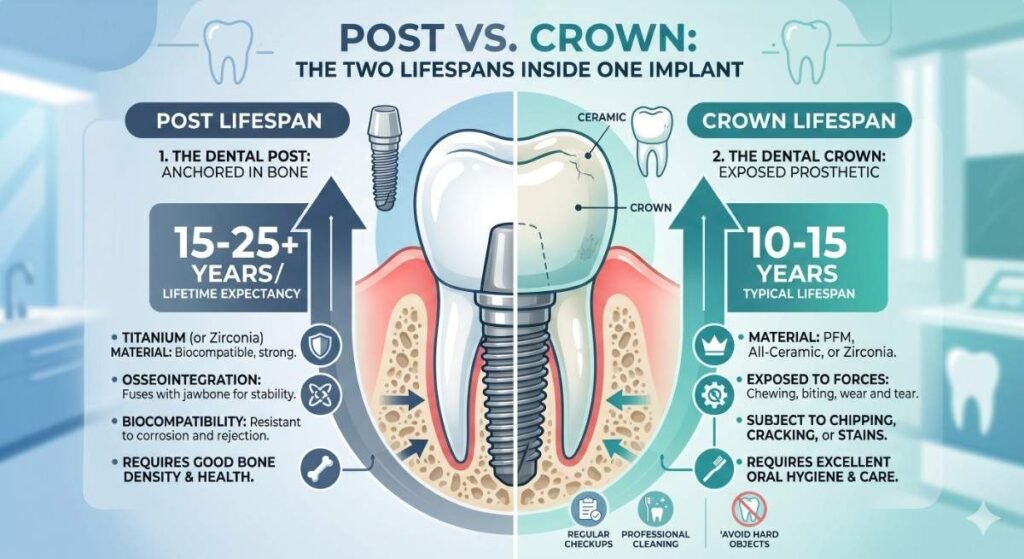
Post vs. Crown: The Two Lifespans Inside One Implant
One of the most common sources of confusion patients encounter is treating the implant as a single entity with one lifespan. Clinically, it is not. There are two components with fundamentally different durability profiles, and understanding this distinction is critical to setting realistic long-term expectations.
The titanium mini implant post is the component that fuses directly with the jawbone through osseointegration. Once successful osseointegration occurs and the patient maintains appropriate oral hygiene and avoids high-load habits, this fixture can remain stable for ten, fifteen, or in documented cases considerably more years. It does not decay, and it does not wear mechanically in the way that visible dental components do.
The prosthetic restoration — whether a crown, bridge, or overdenture — is the component that takes the full force of biting, chewing, and daily oral function. This component does wear. Materials fatigue. Sealing mechanisms (particularly the O-ring in overdenture attachments) degrade. The prosthetic element typically requires professional assessment every 5 to 7 years and mechanical replacement approximately every 7 to 10 years, depending on material quality and functional load.
A patient who is told their mini implants “will last 6 to 9 years” may be receiving accurate information about the restoration component while a more complete clinical picture would note that the underlying titanium post may remain viable and stable for significantly longer — if the correct clinical conditions are maintained.
What Determines How Long Your Mini Implant Lasts? The 4 Clinical Factors
At Kristal Clinic, our implant planning protocol evaluates the most important factors affecting mini dental implant lifespan before assessing a patient’s long-term longevity profile. Understanding where a patient stands on each dimension provides a more accurate durability estimate than a generic year-range answer.
How Bone Density Affects Mini Dental Implant Lifespan
Bone density directly influences implant stability and is one of the strongest predictors of long-term success. . A narrow-diameter implant requires less bone volume to place than a conventional implant — this is one of its primary advantages in patients with ridge atrophy — but it still requires sufficient bone quality to achieve and maintain osseointegration.
Patients with low bone density or significant marginal bone loss are at higher risk of implant mobility and eventual failure, regardless of how diligently they maintain oral hygiene. A 3D cone beam CT (CBCT) scan is essential before treatment planning to assess bone volume, trabecular quality, and cortical thickness at the intended placement site.
Mini Dental Implant Survival Rates in Different Jaw Locations
Where in the mouth the implant is placed has a direct and measurable impact on expected survival. This distinction is rarely communicated clearly in general patient-facing content, and it is one of the most clinically significant variables.
A 2025 systematic review published in Clinical Oral Investigations (Springer) examining 3,787 mini implants supporting overdentures reported markedly different outcomes by anatomical position. Mandibular (lower jaw) placements demonstrated a 7-year cumulative survival rate of 95.6%, while maxillary (upper jaw) placements showed a notably lower rate of 77.1% over a similar follow-up period. The difference is attributed to lower bone density in the maxillary arch and higher occlusal forces at posterior maxillary sites.
Mini implants placed in low-load zones — particularly for anterior tooth replacement in the lower jaw or to stabilize lower overdentures — show the most favorable long-term outcomes. Those placed in high-bite-force posterior zones, especially the upper jaw, carry meaningfully higher failure risk and should be assessed with greater clinical caution.
Smoking, Bruxism, and Other Risk Factors for Mini Implant Failure
Several systemic and behavioral factors affect osseointegration quality and ongoing implant health:
Smoking is the most consistently documented risk factor in implant literature. Nicotine reduces vascular blood flow to the peri-implant tissues, impairs healing, and significantly increases the risk of peri-implantitis — the inflammatory condition around the implant that is the leading cause of late-stage implant failure. Smokers should be informed of this risk transparently before treatment.
Bruxism (teeth grinding) places cyclical overloading stress on narrow-diameter implants that their cross-section is not designed to absorb indefinitely. Over time, this mechanical fatigue can lead to implant fracture — a complication that is significantly harder to manage than implant loosening. Patients with active bruxism may require a night guard as a protective measure.
Systemic conditions including uncontrolled diabetes, autoimmune disorders, and long-term bisphosphonate use can all affect bone remodeling quality and should be disclosed in full during the treatment planning consultation.
How Bite Force and Occlusal Load Influence Mini Implant Longevity
Not all mini implant applications create the same mechanical demands. A mini implant supporting a single crown on a lower front tooth carries vastly less occlusal stress than one used to anchor a full-arch overdenture in the posterior maxilla.
Patients using mini implants primarily for lower denture stabilization — one of their most well-documented and clinically appropriate applications — tend to report better long-term outcomes than those using them for high-load single-molar replacement. The choice of prosthetic material and attachment mechanism also influences wear rates and replacement intervals.
What Clinical Data Shows: Survival Rates and Real-World Evidence
Clinical evidence suggests that mini dental implants can provide reliable long-term performance when placed in suitable cases.
A 2025 systematic review reported a cumulative survival rate of approximately 91.4% for mini implants supporting overdentures. Outcomes were generally stronger in the lower jaw than in the upper jaw due to differences in bone density and loading forces.
While these findings are encouraging, survival rates vary based on patient selection, implant location, oral hygiene, smoking status, and overall health.
For a detailed breakdown of long-term survival percentages, failure rates, and clinical studies, see our complete guide to Mini Dental Implant Success Rates.
Patients seeking a deeper analysis of mini implant clinical performance data may refer to our dedicated page on mini dental implant success rates and clinical evidence.

How Long Does It Take for Mini Dental Implants to Heal?
Mini dental implants typically heal faster than conventional implants because they are often placed using a minimally invasive flapless technique.
Soft tissue healing usually occurs within 1–2 weeks, while osseointegration generally takes 6–12 weeks. Successful healing is essential because early overload during this period can compromise long-term implant stability.
Patients interested in the complete treatment timeline can read our Mini Dental Implant Procedure guide.
Patients pursuing mini implants for overdenture stabilization will find more detailed recovery protocols and prosthetic timelines in our mini implant supported dentures clinical guide.
What Causes Mini Dental Implants to Fail?
Understanding failure is as clinically important as understanding longevity. When mini implants do fail, the causes generally fall into one of four categories:
1. Failed Osseointegration After Mini Dental Implant Placement (early failure). This is the most common failure mode, typically occurring within the first 9 months. Contributing factors include inadequate bone density, surgical technique issues, poor primary stability, or premature occlusal loading before integration is complete. Most failures captured in large-scale studies are early-stage events of this type.
2. Peri-implantitis (late failure). This is an inflammatory condition affecting the soft tissue and bone around the implant, caused by bacterial accumulation at the implant site. It is the leading cause of late-stage implant failure and is directly preventable through consistent oral hygiene and regular professional maintenance. Research indicates that regular professional maintenance reduces peri-implantitis risk by up to 67%.
3. Mini Implant Fracture Caused by Excessive Bite Force . Due to their narrow diameter, mini implants have a finite tolerance for repeated high occlusal forces. Patients with bruxism, those using implants in posterior high-load zones, or those who consistently expose their implants to compressive stress (such as habitual nail-biting or chewing on hard objects) are at greater risk of mechanical fracture — a complication that typically requires full implant removal and site preparation before any replacement.
4. Systemic or pharmacological interference. Certain systemic conditions — uncontrolled diabetes, osteoporosis, active chemotherapy — and medications including bisphosphonates and immunosuppressants can interfere with normal bone healing and remodeling, compromising osseointegration quality and long-term implant health.
Recognizing these failure pathways helps patients understand that longevity is not simply a matter of time — it is a function of ongoing clinical management.

How to Make Your Mini Dental Implants Last Longer
When patients ask what makes mini dental implants last longer, the answer usually involves excellent oral hygiene, regular maintenance visits, and careful management of bite forces. These are not complex — but they require consistent commitment.
Maintain disciplined daily oral hygiene. Brush twice daily using a soft-bristle brush, and ensure thorough cleaning around the implant site. For patients with overdentures, remove the prosthesis nightly for cleaning and allow the soft tissue time to rest. Plaque accumulation at the peri-implant margin is the primary initiating factor for peri-implantitis.
A structured mini implant maintenance routine that includes professional cleanings and periodic radiographic reviews can significantly improve long-term outcomes. Professional cleaning and radiographic monitoring at 6-month intervals allows early detection of marginal bone loss and early-stage peri-implantitis before they progress to structural failure. Prevention is considerably more straightforward than remediation at this stage.
Avoid high-risk habits. Smoking should be discontinued before and after placement wherever possible. Bruxism should be managed with a properly fitted occlusal splint or night guard. Habitual chewing on hard objects — ice, hard candy, pencils — places concentrated stress on narrow implant fixtures.
Respond early to warning signs. Mobility, persistent tenderness, gum swelling around the implant, or an unusual taste near the site are all early warning signals that warrant professional assessment. Early-stage complications managed promptly have substantially better outcomes than those allowed to develop into structural failures.
Follow your clinician’s loading and diet protocol. In the weeks immediately following placement, dietary and functional restrictions exist to protect the osseointegration process. Complying with these instructions during the critical early healing window directly influences long-term implant stability.
Is Your Case Right for Long-Term Mini Implant Success?
Not every patient is equally well-positioned for long-term mini implant success. A realistic longevity estimate requires evaluating the individual patient against the clinical factors discussed above. The following framework may help patients understand where their own situation sits.
Who Is a Good Candidate for Long-Lasting Mini Dental Implants?
| Clinical Factor | Favorable Profile | Less Favorable Profile |
|---|---|---|
| Bone density | Adequate volume confirmed by CBCT, healthy trabecular structure | Significant atrophy, low cortical density, prior bone loss |
| Placement zone | Mandibular anterior, lower overdenture stabilization | Posterior maxillary, upper arch single-tooth molar replacement |
| Smoking status | Non-smoker or confirmed cessation ≥3 months prior | Active smoker, heavy nicotine use |
| Bruxism | No history of teeth grinding; no jaw clenching | Active bruxism, particularly unmanaged |
| Systemic health | No relevant systemic conditions; controlled if present | Uncontrolled diabetes, long-term bisphosphonate use, active cancer treatment |
| Occlusal load | Low-force restoration; denture stabilization | High-load posterior single crown, heavy bite force |
| Hygiene compliance | Reliable daily routine, committed to maintenance visits | Irregular brushing, difficulty with oral hygiene access |
Patients who identify with multiple favorable factors across this profile are strong candidates for long-term mini implant stability. Those with several less favorable factors may benefit from a detailed clinical assessment to determine whether mini implants or an alternative system better aligns with their long-term oral health goals.

💬 Clinical Assessment: Understanding Your Longevity Profile
Answering “how long will my mini dental implants last” requires more than a general framework — it requires a review of your specific bone architecture, oral health history, and restoration goals.
At Kristal Clinic in Istanbul, our implant team offers digital diagnostic reviews for patients who are currently evaluating their options. You can share your existing dental X-rays or CBCT scan directly via WhatsApp and receive a clinical perspective on your specific case — without a commitment to treatment.
Frequently Asked Questions
Are mini dental implants permanent?
The titanium post component of a mini dental implant is designed as a permanent fixture — it fuses with the jawbone through osseointegration and is not routinely removed if functioning correctly. The prosthetic restoration attached to it (crown, bridge, or overdenture) is a separate component that typically requires replacement every 7 to 10 years due to normal wear. So: the structural foundation can be long-term; the visible restoration is not.
How long do mini dental implants last for dentures?
Mini implants used to stabilize lower overdentures have some of the strongest documented long-term outcomes in the mini implant literature. The 2025 Springer systematic review reported a 7-year cumulative survival rate of 91.4% for mini implants supporting overdentures, with mandibular cases showing 95.6% survival. The O-ring attachment mechanism will typically require professional replacement every 1 to 3 years, while the titanium fixtures themselves can remain stable considerably longer.
Do mini dental implants fall out?
Mini implants do not typically “fall out” in the way a loose denture might. Implant failure is usually a gradual biological process — osseointegration failing to occur or peri-implantitis eroding the supporting bone structure. In some cases, a mechanical fracture of the post can occur under high occlusal load. True sudden displacement is uncommon. Patients who notice increasing mobility, persistent discomfort, or inflammation around an implant site should seek professional assessment promptly.
Do mini dental implants fuse with bone like regular implants?
Yes — the osseointegration process works by the same biological mechanism in mini implants as in conventional systems. The titanium surface activates bone cell adhesion and gradual bone formation around the post. The primary difference is the reduced surface area available for this integration due to the narrower diameter, which is why bone density and placement conditions have a proportionally greater influence on mini implant outcomes than they do in conventional systems.
Can smoking shorten mini dental implant lifespan?
Yes, significantly. Smoking impairs blood flow to peri-implant tissues, slows healing, and increases the risk of peri-implantitis — the leading cause of late implant failure. Implant literature consistently identifies smoking as one of the most significant modifiable risk factors for both early and late implant failure. Patients who smoke should discuss this with their clinical team before treatment planning.
How often does the crown on a mini implant need replacing?
The prosthetic crown or restoration attached to a mini implant is subject to functional wear and typically requires professional assessment every 5 to 7 years, with replacement commonly needed at the 7 to 10 year mark. The replacement timeline depends on the material used, bite force, oral hygiene, and whether the patient has habits such as bruxism that accelerate wear.
Medical Disclaimer
The content of this article is provided for general educational purposes only and is not intended to constitute or replace professional clinical advice, diagnosis, or treatment planning. Every patient presents a unique anatomical and medical profile. The longevity figures cited reflect population-level data from peer-reviewed research and do not constitute a guarantee of outcome for any individual patient. Readers are encouraged to consult a qualified implant clinician before making decisions regarding dental treatment. Kristal Clinic provides clinical assessments based on individual diagnostic data, not general statistical averages.
Scientific References
Elsyad MA, Gebreel AA, Fouad MM, Elshoukouki AH. The clinical and radiographic outcome of immediately loaded mini implants supporting a mandibular overdenture. J Oral Rehabil.
Bidra AS, Almas K. Mini implants for definitive prosthodontic treatment: A systematic review. J Prosthet Dent.
Griffitts TM, Collins CP, Collins PC. Mini dental implants: An adjunct for retention, stability and comfort for the edentulous patient. Oral Surg Oral Med Oral Pathol Oral Radiol Endod.
Flanagan D. Fixed partial dentures and crowns supported by very small diameter implants in compromised sites. Implant Dent.
Shatkin TE, Petrotto CA. Mini dental implants: A retrospective analysis of 5,640 implants placed over a 12-year period. Compend Contin Educ Dent.
Aunmeungtong W, Kumchai T, Strietzel FP, Reichart PA, Khongkhunthian P. Comparative clinical study of conventional implants and mini implants supporting mandibular overdentures.
Sendax VI. Mini Dental Implants: Principles and Practice. Dent Today.
Klein MO, Schiegnitz E, Al-Nawas B. Systematic review on survival rates of narrow diameter implants. Clin Oral Implants Res.
Schiegnitz E, Al-Nawas B. Narrow-diameter implants: A systematic review and meta-analysis. Clin Oral Implants Res.
Clinical Oral Investigations. Systematic Review of Mini Implants Supporting Overdentures (2025).
International Journal of Oral & Maxillofacial Implants. Long-Term Outcomes of Mini Implant Overdentures.
Journal of Prosthodontic Research. Survival and Mechanical Complications of Mini Dental Implants.