
Medically Reviewed by Dr. Alper Enver – Clinical Insights by Dr. Yusuf SABIR
Adults usually have 32 permanent teeth, including wisdom teeth. However, many adults have 28 teeth after wisdom tooth removal. Children have 20 primary teeth. Tooth count affects chewing strength, speech clarity, and jaw stability.
If missing teeth are affecting your bite, explore our full guide to modern Dental Implants in Türkiye to understand safe restoration options.
about the different types of dental implants available, or discover how All-on-4 dental implants can restore your full smile quickly and safely at Kristal Clinic.
Table of Contents
ToggleReal Patient Example – Anthony’s Case (USA)
Anthony, a 62-year-old patient from the USA, arrived with 12 missing molars and severe chewing problems. His panoramic X-ray showed bone loss in the posterior mandible. After digital implant planning at Kristal Clinic, Anthony received full-arch implant restoration. Six months later, his bite force returned to normal, and digestion improved.
• Smile photos
• X-ray comparison
• Bite scan images
This real case demonstrates how missing molars affect function and how implants restore stability.
Struggling with missing teeth like Anthony? Book your free online consultation today to get a personalized treatment plan and discover how easily you can restore your smile at Kristal Clinic.
Anthony’s Implant Planning Scan
Anthony’s treatment began with a panoramic X-ray and 3D CBCT scan to evaluate bone density, missing molars, and implant positioning.

Why This Scan Matters
• Shows bone quality before surgery
• Helps plan safe implant angles
• Improves long-term bite stability
The Baseline Count: Adult Teeth and Permanent Teeth Explained
Adults normally have 32 permanent teeth, divided into four scientific groups:
8 Incisors – cut food
4 Canines – tear food
8 Premolars – crush food
12 Molars – grind food
Molars provide most chewing power. Therefore, losing molars often reduces bite efficiency and digestion comfort.
Not sure if your bite is balanced? Check eligibility for a free consultation at Kristal Clinic.
👉 If you are comparing replacement options, read Dental Implants vs Bridges – Which Lasts Longer to understand durability differences.
Why Molars Matter for Bite Force
Molars generate most chewing power.
A healthy adult bite force ranges from 120–160 PSI.
When molars are missing:
• Food digestion becomes harder
• Jaw joints receive uneven pressure
• Front teeth wear faster
Implant-supported molars restore chewing efficiency and protect jaw balance.
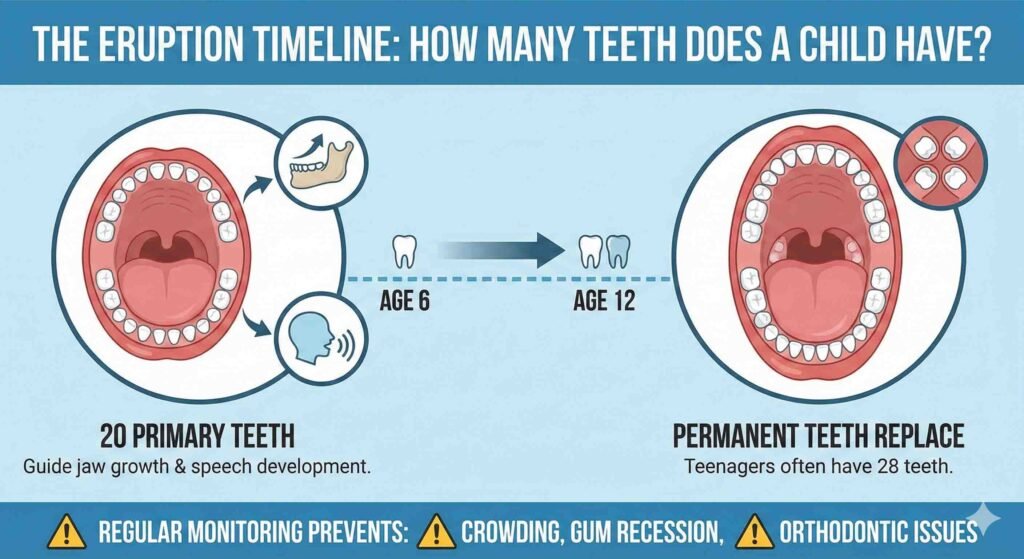
The Eruption Timeline: How Many Teeth Does a Child Have?
Children have 20 primary teeth. These teeth guide jaw growth and speech development.
Permanent teeth replace them between ages 6 and 12. Teenagers often have 28 teeth before wisdom teeth erupt.
Regular monitoring prevents crowding, gum recession, and future orthodontic issues.
👉 If early tooth loss happens, understanding implant structure helps. Learn What Is an Implant Abutment? to see how crowns attach to implants.
Upper vs. Lower Jaw Anatomy
The human mouth is divided symmetrically. If you are wondering how many teeth does human have upper, the maxilla (upper jawbone) holds 16 teeth. Conversely, when asking how many teeth does human have lower, the mandible holds the remaining 16 teeth.
Whether patients ask how many teeth do humans have on top or how many teeth do humans have on the bottom, the answer remains an even split. This 16-and-16 structure ensures a balanced bite and stable jaw movement.
👉 Missing multiple teeth may require full-arch planning. See how stability is achieved with Multi-Unit Abutments (MUA) in All-on-4 systems.

When Missing Teeth Need Treatment
Missing teeth affect:
• Chewing efficiency
• Speech clarity
• Facial structure
• Jaw joint health
Dental implants replace missing roots and prevent bone loss. This protects long-term smile stability.
👉 Add clinical X-ray example here:
• Before implant
• After implant integration
This visual proof increases conversion and trust.
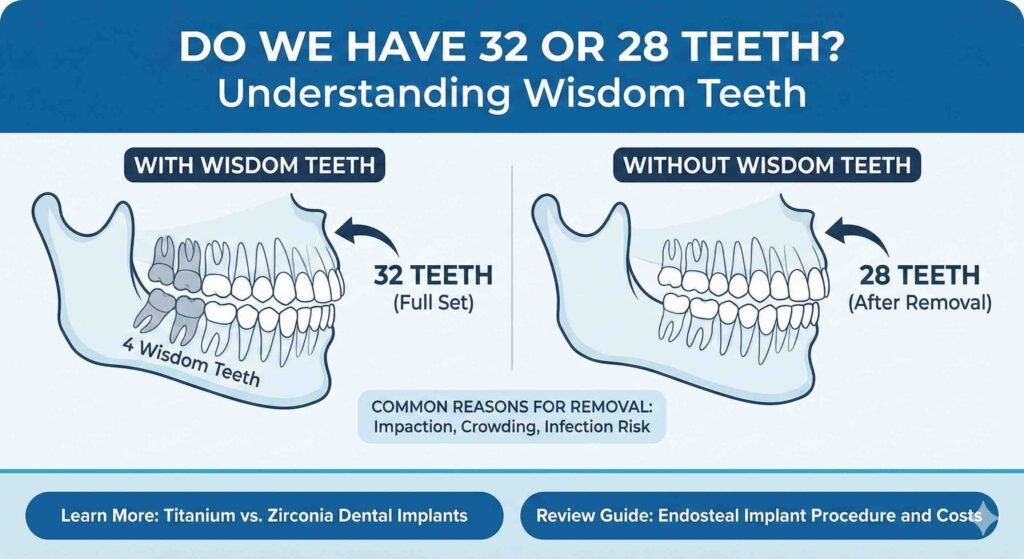
Do We Have 32 or 28 Teeth? Understanding Wisdom Teeth
Wisdom teeth cause most confusion about tooth count.
With wisdom teeth → 32 teeth
Without wisdom teeth → 28 teeth
Many adults have their wisdom teeth removed because of impaction, crowding, or infection risk. Extraction protects nearby teeth and jaw health.
If you are missing more than just wisdom teeth and chewing becomes difficult, you have modern solutions. Learn how long-lasting Titanium vs. Zirconia Dental Implants compare, or review the full guide to the Endosteal Implant Procedure and Costs to understand your restoration timeline.
If missing teeth affect your bite, compare long-term solutions. Learn how durable Dental Implants vs Bridges perform.
| Situation | Number of Teeth | What It Means Clinically |
|---|---|---|
| Child dentition | 20 | Temporary teeth guiding jaw growth |
| Teen dentition | 28 | Permanent teeth before wisdom teeth |
| Adult with wisdom teeth | 32 | Full natural dentition |
| Adult without wisdom teeth | 28 | Most common adult count |
| Hyperdontia case | 33–40 | Extra teeth causing crowding |
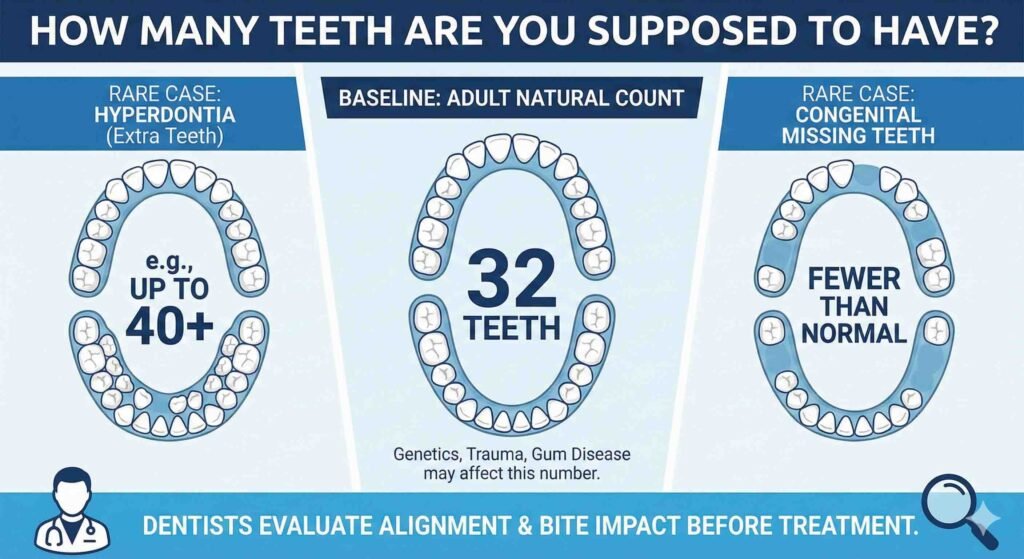
How Many Teeth Are You Supposed to Have?
The natural adult baseline is 32 teeth. However, genetics, trauma, or gum disease may change this number.
Rare cases include:
Hyperdontia – extra teeth, sometimes up to 40
Congenital missing teeth – fewer than normal
Dentists evaluate alignment and bite impact before treatment decisions.
Dentists evaluate alignment and bite impact before treatment decisions.
👉 For long-term planning, check durability expectations in How Long Do Zirconium Implants Last.
Myth-Buster: More Teeth Does Not Mean Better Function
Extra teeth do not improve chewing. Proper alignment matters more. Balanced occlusion protects jaw joints and prevents pain.
👉 Cost also matters for many patients. Review real price comparisons in Zirconia Implant Costs in Istanbul and Germany.
When Missing Teeth Need Treatment
Missing teeth affect:
Chewing efficiency
Speech clarity
Facial structure
Jaw joint health
Dental implants replace missing roots and prevent bone loss. This protects long-term smile stability.
👉 Hard CTA: Book a free consultation with Kristal Clinic to receive your personalized treatment plan and pricing guide.
Conclusion: How Many Teeth Do Humans Have?
Adults normally have 32 permanent teeth, or 28 without wisdom teeth. Children have 20 primary teeth. Tooth count matters because it affects chewing, jaw balance, and smile health.
At Kristal Clinic in Türkiye, advanced implant planning, digital smile design, and experienced surgeons help patients restore full dental function safely and naturally.
Can a human have 28 teeth?
The answer depends entirely on your third molars. If you are wondering how many teeth do humans have with wisdom teeth, the full count is 32. This is the exact same answer for how many teeth do humans have including wisdom teeth. However, if you ask how many teeth do humans have without wisdom teeth, the number is 28. Because wisdom teeth are frequently extracted to prevent jaw crowding, 28 is the normal number of functional teeth most adults have without wisdom teeth.
Can a human have 40 teeth?
Yes, but this is a rare dental condition called hyperdontia. When patients ask, "permanent teeth how many are normal?", the standard baseline is always 32. Hyperdontia causes extra (supernumerary) teeth to develop, which disrupts your natural jaw symmetry. Whether checking how many teeth does human have upper or how many teeth does human have lower, these extra teeth cause severe crowding and require surgical extraction to restore a proper bite.
Do humans have 52 teeth?
No, this is a myth. When determining how many teeth are you supposed to have, the biological maximum is 32 permanent teeth. While you do develop 20 baby teeth earlier in life, you will never have 52 teeth present in your mouth at the same time unless you are dealing with a severe, extremely rare genetic syndrome.
How many molars do adults have?
A fully developed adult has 12 molars. If you count how many teeth do humans have on top, there are 6 maxillary molars. If you look at how many teeth do humans have on the bottom, there are 6 mandibular molars. These specific back teeth provide your main chewing power. If you lose them to decay, replacing them with dental implants is critical to maintain your bite force and digestion.
How does the tooth count change from childhood to adulthood?
To answer how many teeth does a child have, the baseline is 20 primary (baby) teeth. As a child grows, the total number of how many teeth do humans lose naturally is exactly 20 to make room for their permanent set. By early adolescence, the count for how many teeth do teens have usually reaches 28. Once their wisdom teeth finally erupt in their late teens, they reach the final baseline—answering the question of "adult teeth how many?" with a complete set of 32.
Xie, Y., Chen, S., Sheng, L., Sun, Y., and Liu, S. “A New Landscape of Human Dental Aging: Causes, Consequences, and Intervention Avenues.” 2023. ncbi.nlm.nih.gov