If you’re considering a dental implant or are just curious, you’ve likely heard terms like “abutment,” “fixture,” and “crown.” It can feel like learning a new language. But understanding the various dental implant parts is the key to demystifying the entire process and feeling confident about your treatment.
This guide is designed to be your ultimate resource. We’ll move beyond a simple list and provide a clear, visual journey through every component of a modern implant system. By the end, you’ll not only know the names but also their functions, materials, and how they work in harmony to restore your smile.
Table of Contents
ToggleThe 3 Primary Parts of a Dental Implant System
If you’re considering a dental implant, you know it replaces a missing tooth. But what exactly is it made of? Understanding the various dental implant parts—from the foundational screw to the visible crown—is key to feeling confident about your procedure. This guide goes beyond a simple definition to give you a complete, visual journey through the entire system, including the crucial surgical components most guides miss.
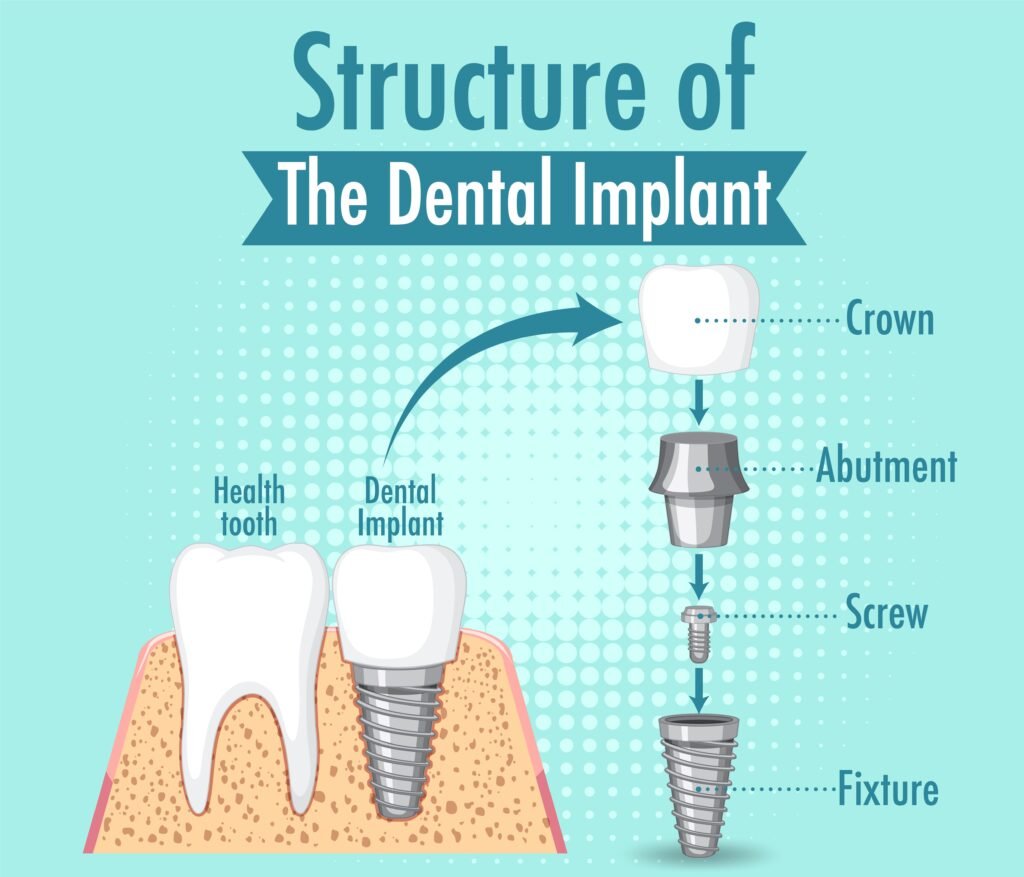
At its heart, every dental implant, whether for a single tooth or supporting a denture, consists of three fundamental components of a dental implant. Think of this as the essential trio that makes up your new artificial tooth.
1. The Implant Fixture (The Post): Your New Root
The implant fixture is the foundation of the entire structure. This is the screw-like implant post that is surgically placed into your jawbone. According to clinical studies, these fixtures are typically made from medical-grade titanium (Ti-6Al-4V alloy), a material with a documented osseointegration success rate of over 95% after 10 years.
Function: It acts as an artificial tooth root, providing a stable anchor.
Design: Its threaded design isn’t accidental. The threads increase surface area, promoting bone fusion through osseointegration — the key process explained in our endosteal implant guide.
For more on implant placement and healing, see how long a dental implant takes.
2. The Abutment: The Critical Connector
Sitting atop the implant fixture is the abutment. This component is the crucial link that connects the root (the fixture) to the crown (the visible tooth). Sitting atop the implant fixture is the abutment — the crucial link connecting the root to the crown.
The abutment in dental implants is a precision-engineered component ensuring your restoration stays securely in place.
Function: To securely support and attach the final prosthetic crown.
Materials: Sitting atop the implant fixture is the abutment — the crucial link connecting the root to the crown. The abutment in dental implants is a precision-engineered component ensuring your restoration stays securely in place.
3. The Prosthetic Crown (The Restoration): Your Visible Tooth
This is the part everyone sees—the final crown restoration. It’s custom-made to match the size, shape, and color of your natural teeth, ensuring a seamless and beautiful smile.
Learn about material options and design differences in our guide on types of dental implants.
Function: To restore the function and appearance of your missing tooth.
Materials: The most common materials are all-ceramic (or all-porcelain) for a supremely natural look, and porcelain-fused-to-metal (PFM) for a blend of strength and aesthetics.
For full-mouth transformations, explore All-on-Four dental implants, a revolutionary technique that uses just four fixtures to support an entire arch of teeth.
Beyond the Basics: Surgical & Procedural Components
The three main dental implant parts tell only half the story. During the procedure, your dentist uses several other critical pieces that are essential for success.
Surgical Guide: For Pinpoint Precision
Before any drilling begins, many dentists use a surgical guide. This is a key part of computer-guided implant surgery. Research has shown that using a surgical guide can improve placement accuracy by up to 90% compared to freehand placement, leading to better long-term outcomes. This custom-made, transparent appliance fits over your teeth and gums with pre-drilled channels that show the dentist the exact angle, depth, and position for placing the implant fixture.
Healing Abutment / Healing Cap
Immediately after placing the implant fixture, a healing abutment (or healing cap) is attached. This is a temporary component that plays a vital role.
It protrudes slightly through the gumline, keeping the space open while the gum tissue heals around it.
It shapes the gum tissue to form a natural-looking collar, ready for the final abutment and crown later.
This is a key distinction many guides miss: the healing abutment is temporary and is replaced by the final abutment once the gums have healed.
Impression Coping / Scan Body
How does your dentist create a crown that fits your implant system perfectly? They use an impression coping. This precision step ensures accuracy for permanent restorations, especially in permanent dentures and full-arch prosthetics.
How the Parts Come Together: The Implant Journey Visualized
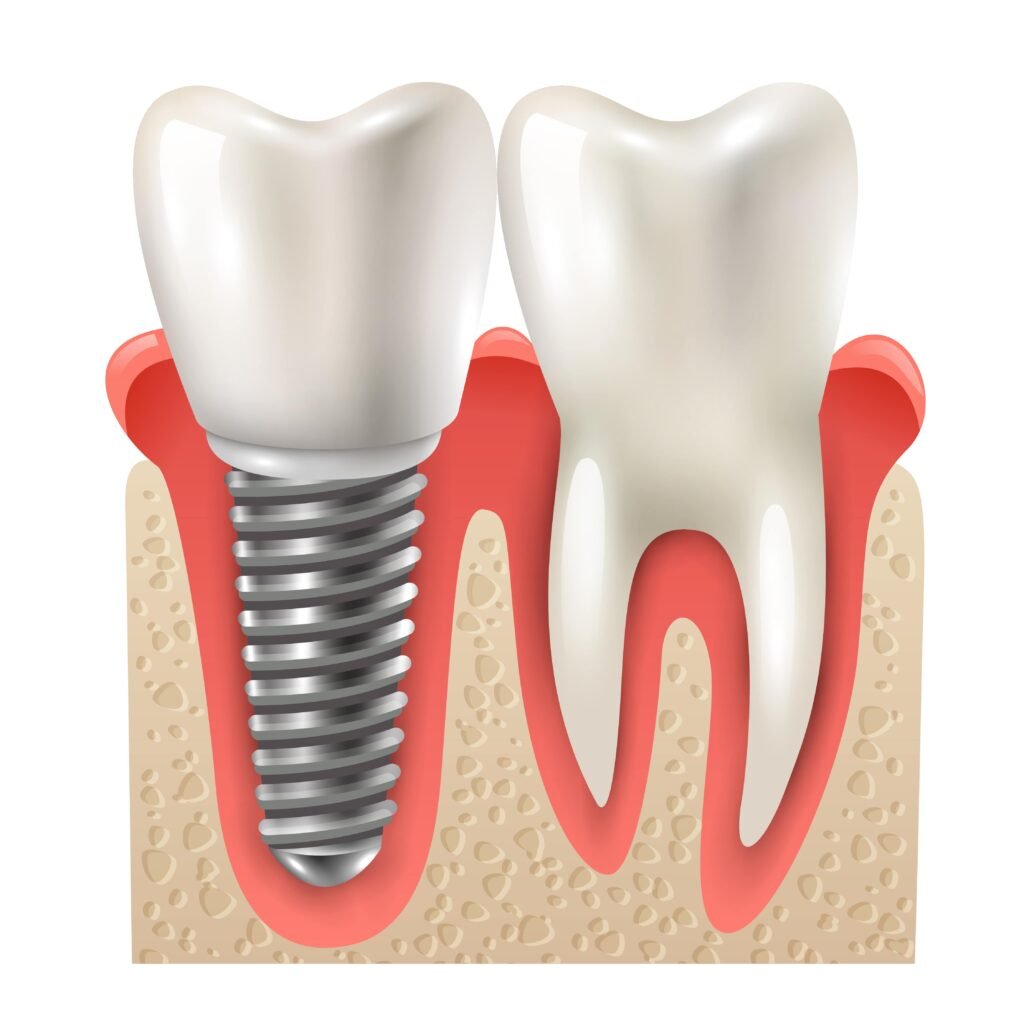
Let’s bring all these dental implant parts together. The process can be broken down into a few key stages, which our diagram below illustrates.
Missing Tooth: The gap in the jawbone where the natural tooth root is absent.
Fixture Placed: The titanium implant post is surgically inserted into the jawbone.
Healing Abutment Attached: The temporary healing cap is placed, and the gum is stitched closed around it to heal.
Final Abutment Connected: After healing, the healing abutment is removed, and the final abutment is screwed onto the fixture.
Crown Secured: The custom-made prosthetic crown is either cemented or screwed onto the final abutment, completing the restoration.
Choosing Your Components: Materials, Brands, and Customization
Not all dental implant components are created equal. Whether you’re considering zirconia or titanium, our comparison of titanium vs. zirconia dental implants explains which material best suits your needs. it’s also important to understand the disadvantages of mini dental implants before considering smaller-diameter solutions. These mini options can be useful in narrow bone cases but may have limitations in longevity and strength.
Stock vs. Custom Abutments
This is a critical choice that impacts both aesthetics and cost.
Stock Abutments: These are pre-fabricated in standard shapes and sizes. They are more cost-effective and work well in many situations, particularly back teeth.
Custom Abutments: These are milled specifically for your mouth. They offer a superior fit and can be designed to create a more ideal and natural gumline contour, which is especially important for front teeth. The choice of dental implant component materials (like zirconia for custom abutments) enhances the aesthetic result.
For advanced cases requiring bone volume restoration, our article on bone grafting for dental implants in 2025 – get cost & recovery shows how the foundation of your implant (the fixture) depends on healthy bone.
An Overview of Major Implant Systems
It’s helpful to know that there are several major implant system brands on the market (e.g., Nobel Biocare, Straumann, Zimmer Biomet). Each has its own proprietary design for the abutment connection. This means the parts must be compatible; a Straumann abutment won’t fit a Nobel fixture. A skilled dentist will choose a reliable system and ensure all parts of the dental implant are perfectly matched.
Specialized Parts: Dental Implant Parts for Dentures
For patients missing all their teeth, dental implant parts for dentures come into play. For patients missing all teeth, specialized dental implant parts for dentures provide a full-arch solution. These include ball attachments and bar-clip systems for enhanced stability — transforming comfort and confidence like :
Ball Attachments: Implants have ball-shaped abutments that snap into sockets in the denture.
Bar Clips: A metal bar connects multiple implants, and the denture clips onto this bar for immense stability.
These systems use the same fundamental implant fixture but different abutments and prosthetics to achieve the goal.
Our sources include:
Manufacturer Clinical Data