Types of Dental Implants (2026): The 3 Main Types, Costs and How to Choose

Written and medically reviewed by Dr. Anas Zemzemi | Last reviewed: 5 November 2026 | Sources at the end of this guide

What are the 3 types of dental implants? The different types of dental implants are grouped by where the implant sits. The three main types of dental implants are endosteal implants (screws placed in the jawbone), subperiosteal implants (a metal frame on top of the jawbone, under the gum) and zygomatic implants (long implants anchored in the cheekbone when the upper jaw has too little bone). Mini dental implants are a narrower kind of endosteal implant. Each type can hold a single crown, a bridge, a denture or a full arch of teeth. Which one you need depends mainly on how much bone you have and how many teeth you are replacing.

Questions about which implant type fits you?

Ask us on WhatsApp

Key takeaways

  • 3 main types by placement: endosteal, subperiosteal and zygomatic. Mini implants are a narrow endosteal implant.
  • 4 ways implants replace teeth: single implant crown, implant bridge, implant-retained denture and full arch (All-on-4 / All-on-6).
  • Your jawbone decides the type: with enough bone, endosteal implants are used; with too little bone, options include a bone graft, a sinus lift or zygomatic implants.
  • At Kristal Clinic in Istanbul a single implant with abutment and crown starts from $300; your 3D scan, plan and crown are included.
  • Medically reviewed by Dr. Anas Zemzemi on 5 November 2026.

This guide covers every option, from the best type of dental implant for a single tooth to the types of full mouth dental implants, with 2026 prices and services for dental implants in Istanbul.

What This Guide Covers (Quick Navigation)

What Types of Dental Implants Are There? Two Ways to Group Them

You will see guides that list 3 types and others that list 9. Both are right, because clinics group implants in two ways:

  1. By where the implant is placed (the implant itself): endosteal, subperiosteal, zygomatic and mini implants.
  2. By what the implant replaces (the teeth on top): a single tooth, an implant-supported bridge, implant-retained dentures or a full arch.

So when people ask what are the different types of dental implants, the full answer covers both: the type of implant in the bone, and the type of teeth fixed to it.

The 3 Main Types of Dental Implants (by Placement)
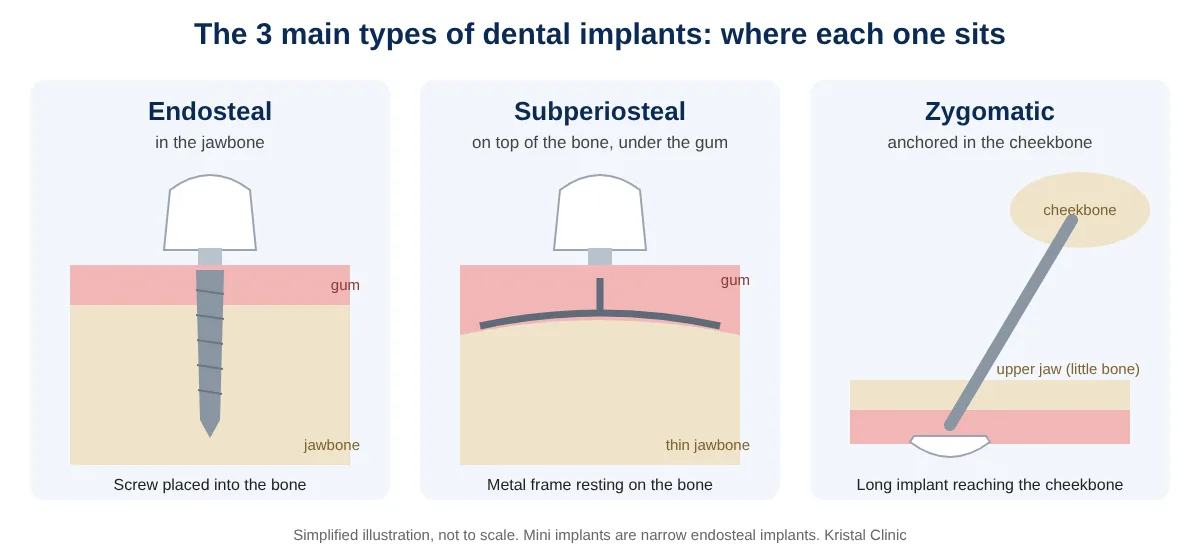
Diagram of the 3 main types of dental implants: endosteal in the jawbone, subperiosteal on top of the bone under the gum, and zygomatic anchored in the cheekbone
Illustration: where each main type of dental implant sits. Simplified, not to scale.

Endosteal implants

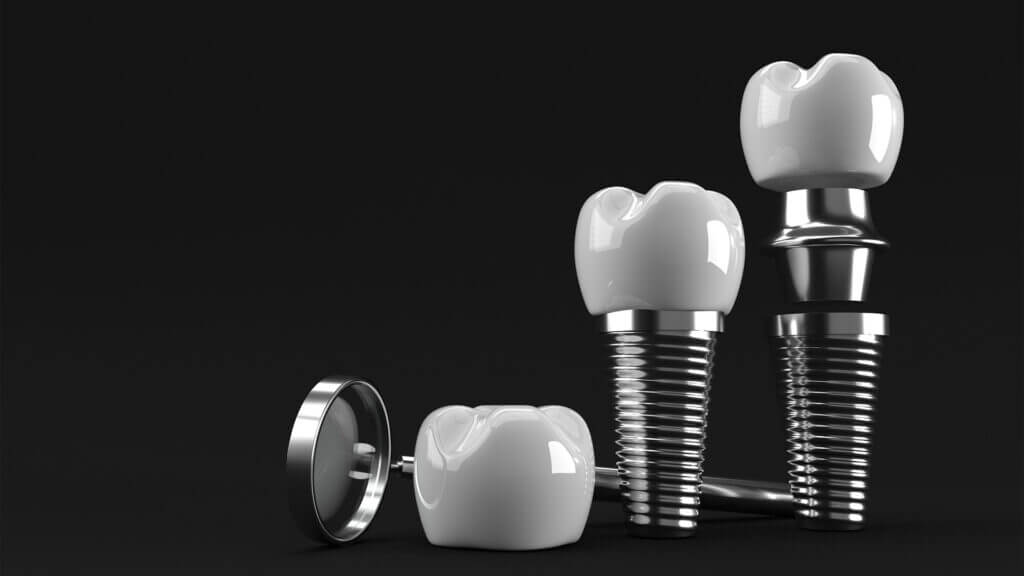
Endosteal implants are small screws, usually titanium, placed directly into the jawbone. Once the bone has healed around them, they hold a crown, a bridge or a denture. They need enough healthy bone; where the bone is thin, a bone graft may be done first. Read our endosteal implant guide for the steps and costs.

Subperiosteal implants

Subperiosteal implants are a custom metal frame that rests on the jawbone beneath the gum tissue, with posts that come through the gum to hold teeth. They are an option for some people who cannot have a bone graft. Kristal Clinic offers subperiosteal implants.

Zygomatic implants

Zygomatic implants are much longer implants anchored in the cheekbone (zygoma) instead of the upper jaw. They are used for upper full-arch cases with severe bone loss and can avoid a bone graft or sinus lift. Kristal Clinic offers zygomatic implants, placed by our dentist.

Mini dental implants

Mini dental implants are narrower endosteal implants. They are mainly used to stop a lower denture from moving or where there is little space. They are not right for every case: see the disadvantages of mini dental implants. For everything about this type, read our complete guide to mini dental implants.

Types of Dental Implants by What They Replace

Single tooth implant

One implant with one crown replaces one missing tooth. The implant is placed in the jawbone, an abutment is added once it has healed, and a crown is fixed on top. Unlike a tooth-supported bridge, nothing is done to the teeth next to it[1]. It needs enough bone at the gap; if the bone is thin, a bone graft may come first.

Implant-supported bridge

Two or more implants hold a bridge of several teeth in a row. Compare implants vs bridges under “Which type of dental implant is right for you?” below. For a metal-free option, see our zirconia dental bridge guide.

Types of dental implants for dentures

Implant-retained dentures clip onto 2 or more implants, so the denture does not move when you eat or speak. Fixed versions are often called permanent dentures.

Types of full arch dental implants

A full arch replaces all the teeth in one jaw with a fixed bridge on 4 to 6 implants: All-on-4 dental implants use 4, All-on-6 uses 6, and 3 on 6 dental implants in Turkey use 6 implants holding 3 bridge sections. Full-arch bridges sit on multi-unit abutments.

Missing several teeth or a full arch?

Get a full-arch plan on WhatsApp

Every Type of Dental Implant and Its Cost, Compared

Types of dental implants and cost at Kristal Clinic, Istanbul (2026 prices)

TypeWhere it sitsBest forBone neededTreatment timePrice from
Endosteal (single)In the jawboneOne missing toothEnough healthy bone3–6 months healingfrom $300
MiniIn the jawbone (narrow)Holding a lower dentureLess than standard3–6 months healingFree quote
SubperiostealOn the bone, under the gumSome cases with low boneLittle3–6 months healingFree quote
ZygomaticIn the cheekboneUpper jaw, severe bone lossUses the cheekbone3–6 months healingFree quote
Implant bridge2+ implantsSeveral teeth in a rowEnough at each implant3–6 months healingFree quote
Implant-retained denture2+ implantsLoose denturesVaries3–6 months healingFree quote
All-on-4 / All-on-64 or 6 implants per jawAll teeth in one jawVaries3–6 months healingFree quote

Not sure which type of dental implant fits you? Send us a photo or X-ray and get a free plan with the implant type, brand and price in writing.

Get your free implant quoteAsk about prices on WhatsApp

Types of Dental Implants Pictures: Real Cases

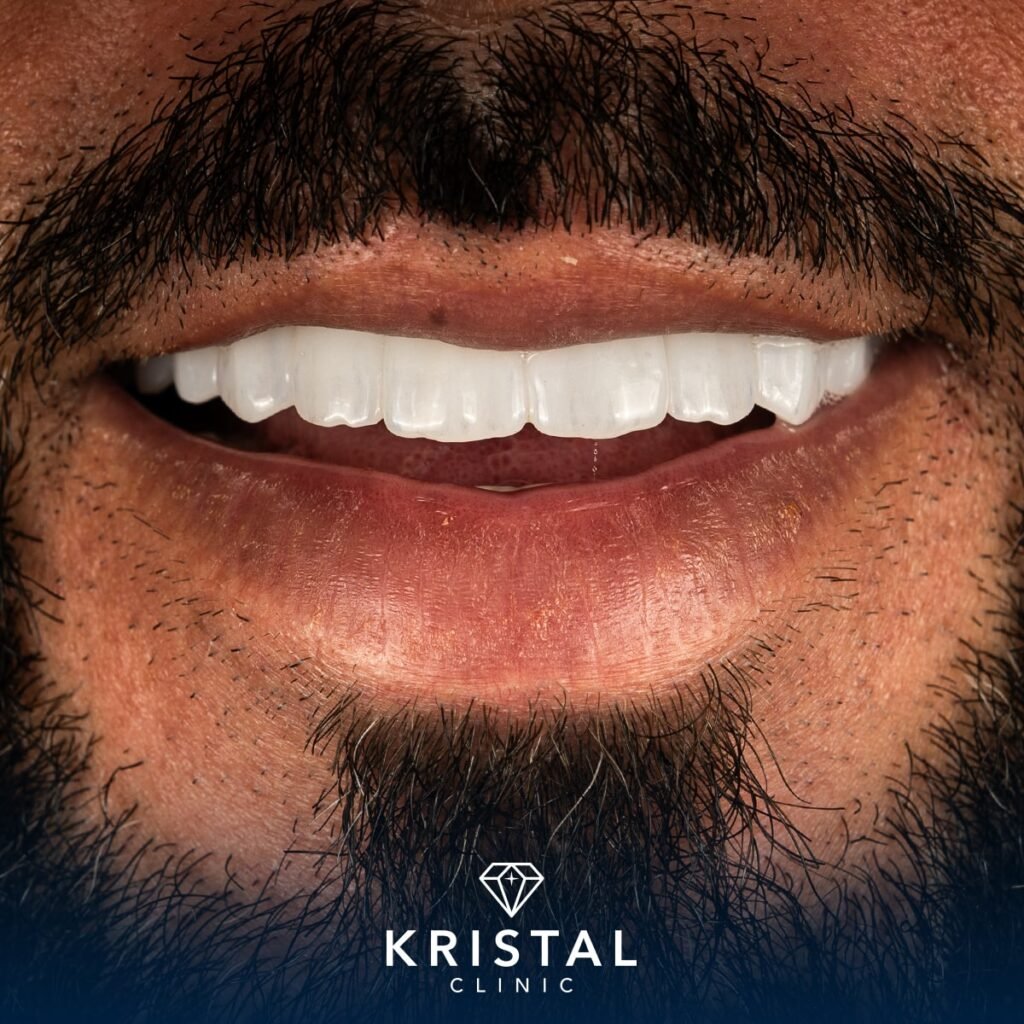
Before and after dental implants at Kristal Clinic: missing upper teeth (bottom) restored to a full, natural-looking smile (top)
Before (bottom) and after (top): a Kristal Clinic dental implant patient. Results vary.

Reviewing types of dental implants pictures before and after can help set realistic expectations for your final fixed smile. This visual evidence of previous patient success is vital when assessing your options.

See examples of fixed, permanent dentures and the aesthetic transformations achieved: Permanent Dentures: Celebrity Dental Implants Before and After.

For more full mouth before and after pictures, see our All-on-4 before and after guide.

Want to see more cases like yours?

Ask for similar cases on WhatsApp

Types of Dental Implants Materials, Parts and Brands

Most implants are made of titanium. Zirconia (ceramic) implants are a metal-free option; compare them in titanium vs zirconia dental implants. See how long zirconium implants last and what zirconia implants cost.

Every implant has three parts: the implant post in the bone, the abutment and the crown (see dental implant parts and what is the abutment in dental implants). Types of abutments for dental implants include standard abutments for a single tooth and multi-unit abutments for full-arch bridges. Types of dental implant crowns include zirconia and porcelain-fused-to-metal crowns; see the best material for dental implant crowns.

We use Straumann and Hiossen implants, and the brand is written on your treatment plan. For how the brands compare, see the top 10 dental implant companies.

Dental Implant Cost

Types of Dental Implants and Cost

Types of dental implants cost different amounts because each needs a different number of implants, parts and surgery time. The table above shows the starting price for each type at Kristal Clinic in Istanbul; for a single implant, the price depends on the brand you choose.

The types of dental implants cost for full mouth reconstruction varies by country: compare types of dental implants UK prices, or the types of dental implants cost in India and types of dental implants cost in Pakistan, in our dental implant cost by country guide. Price also depends on the brand: see the types of dental implants brands we use in the materials section above. Always ask which brand and type of implant your quote includes.

Only if your scan shows you need them, these are priced separately and confirmed in writing before treatment: bone graft, sinus lift, tooth extraction and IV sedation.

Every price includes: CBCT and panoramic X-ray, digital plan and surgical guide, the implant (brand in writing), abutment, final lab crown, local anaesthesia, medication and one follow-up per visit.

For a full price list in Istanbul, see dental implant cost in Turkey. For full-arch prices, see the All-on-4 dental implants cost guide.

Send your X-ray and get your exact price in writing.

Get my price on WhatsApp

Which Type of Dental Implant Is Right for You?

  • One missing tooth and enough bone → a single endosteal implant with a crown.
  • Several teeth missing in a row → an implant-supported bridge.
  • All teeth missing in one jaw → All-on-4 or All-on-6, or an implant-retained denture.
  • Upper jaw with severe bone loss → a bone graft or sinus lift first, or zygomatic implants.
  • A lower denture that moves → 2 or more implants (sometimes mini implants) to hold it.

Implants may need to wait or may not be suitable if you smoke heavily[4], have uncontrolled diabetes, have had radiotherapy to the head and neck, or take certain bone medicines (bisphosphonates)[1], or have active gum disease[5].

If implants are not right for you, the usual alternatives are a tooth-supported bridge, which needs the neighbouring teeth to be prepared, or a removable denture (fixed options on implants are covered in our permanent dentures guide). Neither replaces the tooth root, while an implant helps maintain the bone at the gap[1].

Your dentist decides the type after an examination and a 3D (CBCT) scan.

Send your X-ray for a free planSend it on WhatsApp

Risks of Each Type of Dental Implant

All implant types carry some risk: the gum wound reopening after surgery, the implant not fusing with the bone, altered sensation from nerve injury in the lower jaw, a sinus perforation in the upper jaw[1], and gum inflammation around the implant later (peri-implantitis)[5].

Zygomatic implants are a longer, more complex operation and should be placed by an experienced surgeon[3]. Mini implants are mainly used to hold dentures[2].

For long-term results of full-arch treatment, see All-on-4 success rates and survival data.

Lifespan and care by type

Clean around your implants every day and keep regular check-ups; smoking and a history of gum disease raise the risk of peri-implantitis[4][5].

types of dental implants

Types of Dental Implant Procedures: Steps and Timeline

The entire process takes several months due to the body’s natural healing requirements.

  1. Online consultation: send photos or an X-ray for a free plan and quote.
  2. Visit 1 in Istanbul: 3D (CBCT) scan, digital plan and implant placement.
  3. Healing: the bone fuses with the implant, usually over 3 to 6 months.
  4. Visit 2: abutment and final crown, bridge or full arch.

For a detailed timeline, see how long dental implants take.

Planning your trip to Istanbul?

Plan my visits on WhatsApp

Types of Dental Implants: Questions Patients Ask

What are the four different types of dental implants?

Some guides list four: endosteal, subperiosteal, zygomatic and mini implants[1][2][3]. Mini implants are a narrow kind of endosteal implant, so this guide counts 3 main types plus mini.

What is the newest type of dental implant?

There is no single newest type. The main newer option is the metal-free zirconia (ceramic) implant; see how it compares with titanium in the materials section above.

What should I know before getting dental implants?

  • You need a 3D (CBCT) scan to check your bone; if it is thin, a bone graft or sinus lift may come first.
  • Gum disease should be treated first[5].
  • Smoking raises the risk of implant failure[4].
  • Diabetes should be under control[1].
  • Standard implants need about 3–6 months of healing before the final teeth, so plan your trips around it (see how long dental implants take).

Conclusion: Choosing Your Implant

You now have a comprehensive understanding of the different types of dental implants and the factors influencing the cost types of dental implants you are considering. The best type of dental implant for you is the one recommended by an experienced specialist after a detailed 3D scan and clinical assessment.

Your Final Step: You have the knowledge; now, take the action. Schedule a virtual consultation to discuss the most suitable endosteal implant or full-arch solution for your case and receive a personalized cost quote.

READY FOR YOUR FIXED SMILE? After reviewing the types of full mouth dental implants available, the next clinical step is a detailed 3D Scan to assess your bone. Schedule a Free Virtual Consultation Today and take the next step toward permanent teeth.

Schedule a Free Virtual ConsultationWhatsApp us

Open Monday–Saturday, 9:00–19:00 · +90 549 520 5000

Sources

  1. Gupta R, Gupta N, Weber KK. Dental Implants. StatPearls, NCBI Bookshelf (updated 2023). Implant types, healing time, contraindications, complications.
  2. Upendran A, Gupta N, Salisbury HG. Dental Mini-Implants. StatPearls, NCBI Bookshelf (updated 2023). Mini implants for retaining dentures.
  3. Polido WD, Machado-Fernandez A, Lin WS, Aghaloo T. Indications for zygomatic implants: a systematic review. International Journal of Implant Dentistry. 2023;9:17.
  4. Mustapha AD, Salame Z, Chrcanovic BR. Smoking and Dental Implants: A Systematic Review and Meta-Analysis. Medicina (Kaunas). 2021;58(1):39.
  5. Risk Factors for Peri-Implantitis: Effect of History of Periodontal Disease and Smoking Habits. A Systematic Review and Meta-Analysis.

This guide is general information, not a diagnosis. The right type of dental implant for you can only be decided after an examination and a 3D scan by a dentist. Medically reviewed by Dr. Anas Zemzemi on 5 November 2026.