
Author byline Medically Reviewed by Dr. Dr. Anas Zemzemi,
Credential : Kristal Clinic Istanbul — June 2026.
Last Updated : June 2026
Quick Answer
If a dentist has told you that you need a bone graft before you can get a dental implants procedure, evaluating mini dental implants vs bone grafting is often the first alternative patients ask about. In many cases, a mini dental implant’s narrower diameter allows it to be placed in bone that’s too thin or resorbed for a standard implant, which means some patients who would otherwise need grafting can avoid that step entirely.
That isn’t true for everyone, though. How much bone loss you have, what you’re trying to restore — a loose lower denture versus a single back molar, for example — and how much you value speed over maximum long-term load capacity all affect whether mini implants are a genuine substitute for grafting, or just a different way to delay the same underlying decision.
Table of Contents
ToggleDecision Framework: Choose the Right Path for Your Jaw Structure
Before committing to a treatment path, use this operational breakdown to determine your next clinical step:
When to Action Mini Implants: If you are securing a loose lower denture or restoring narrow front teeth with minimal bone volume, you can bypass grafting. Refer to our mini dental implants complete clinical guide to map out your immediate single-stage surgical timeline.
When to Action Bone Grafting: If you are replacing a high-load back molar or have severe, multi-directional jaw resorption, you must prioritize standard implants with a preliminary graft to establish long-term occlusal (bite) stability.
Take the Next Step
Don’t guess how much jawbone volume you have left. You can start a WhatsApp chat with our clinical team right now to submit your panoramic X-ray or CT scan for a direct, remote evaluation by our implantologists.
The Fork in the Road: Why Bone Loss Forces This Choice
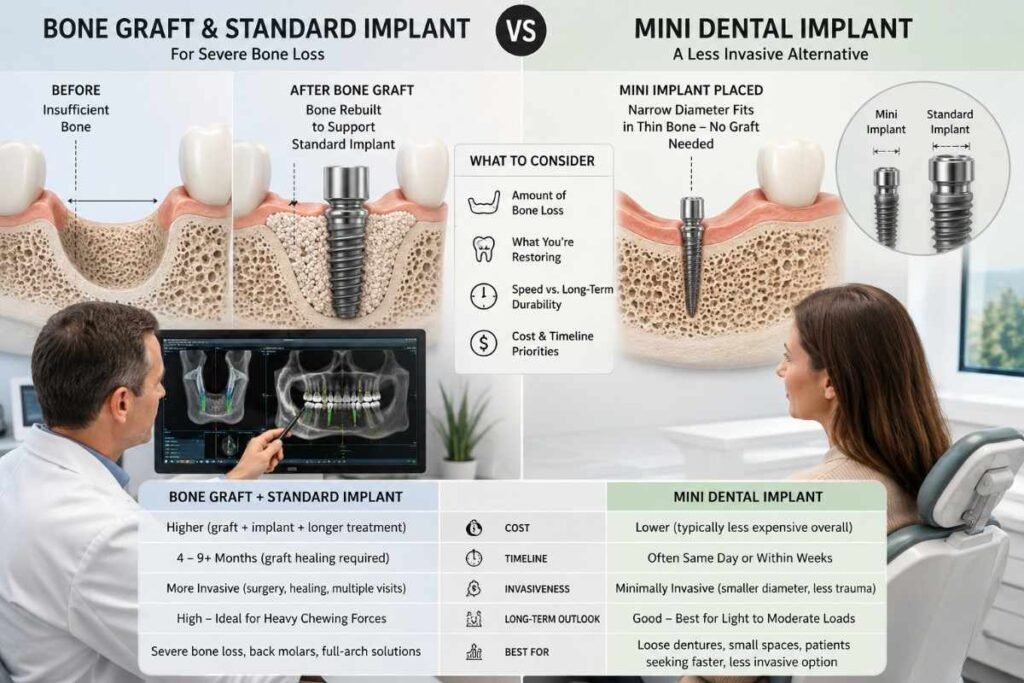
When a tooth is lost, the jawbone beneath it is no longer stimulated by chewing forces and begins to resorb. Ridge width can drop substantially within the first year after extraction, and the longer a gap or a loose denture sits there, the more this narrowing tends to progress.
Ridge resorption is the clinical term for this bone-volume loss — and it’s the root cause that makes the mini-implant-vs-bone-graft decision necessary at all.
Standard implants generally need a certain minimum width and height of healthy bone to integrate securely — which is exactly why bone grafting gets recommended so often. Mini implants exist partly because their reduced diameter sidesteps part of that requirement: they can frequently be placed in ridges that have already narrowed, without an additional augmentation step first.
This makes the choice less about which implant is objectively “better” and more about matching the tool to the anatomy and the goal — a theme that runs through every section below.
Mini Implants vs Bone Graft and Traditional Implant: How the Cost Comparison Actually Works
Choosing mini implants vs bone graft to avoid grafting typically costs less overall than the combined price of a bone graft plus a standard implant, mainly because you’re paying for one procedure instead of two and skipping the additional healing-stage visit that grafting usually requires. This is the heart of the mini implants vs bone graft and traditional implant cost comparison.
Exact figures depend on your clinic, the graft material involved, and how many implants you need, so we won’t repeat specific pricing here — our dedicated mini dental implant cost guide and bone grafting cost and recovery guide both break this down in detail.
For patients researching mini dental implants vs bone grafting Turkey price options while comparing treatment in Türkiye, the relative cost gap between the two paths tends to hold proportionally. If you’re specifically evaluating treatment abroad, our guide to mini dental implants in Türkiye explains local pricing, treatment packages, and what international patients can expect. The savings from choosing mini implants to avoid bone grafting don’t disappear simply because you’re receiving treatment overseas.

Mini Implants vs Bone Graft: Recovery and Timeline Differences
Mini implants vs bone graft recovery timelines differ sharply. Bone grafting is a “wait and heal” procedure. Depending on the size and type of graft, initial healing often takes one to two weeks, soft tissue closure another few weeks, and full bone maturation around three to six months before an implant can usually be placed on top of it.
Mini implants take a different route. When primary stability at placement meets the clinical threshold for immediate loading, a functional restoration can sometimes be fitted the same day — no separate healing-then-place sequence required. This isn’t guaranteed in every case; it depends on insertion torque, bone quality, and the dentist’s clinical judgment at the time of placement.
Put simply: the graft-first path is usually measured in months before you reach a final result, while the mini implant path can sometimes be measured in days — at the cost of the long-term load capacity discussed further down.
Mini Implants vs Bone Graft: Which Is More Invasive, and Which Hurts More?
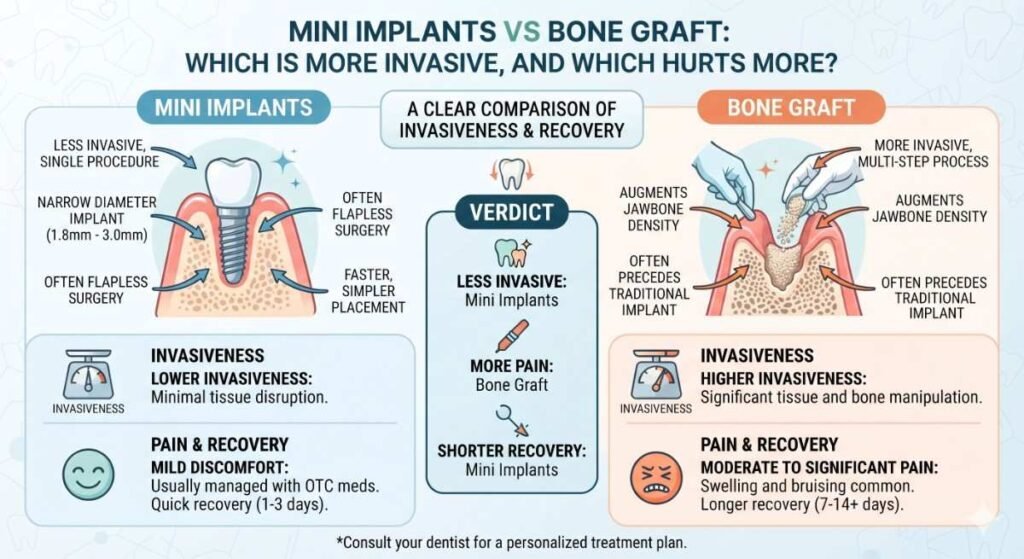
Mini implants vs bone graft pain is one of the most common patient questions, and the answer is consistent: mini dental implants are usually placed using a flapless technique — no incision, no suturing in most cases — which generally means less swelling and a shorter discomfort window afterward.
Bone grafting typically involves a small flap, placement of the graft material, sometimes a membrane, and sutures, which is a larger surgical footprint and is often associated with more post-operative swelling and a longer recovery from discomfort, particularly with larger grafts like a sinus lift. What is more painful a bone graft or a mini dental implant? On average, the flapless mini implant route tends to involve less post-operative discomfort than a staged grafting procedure — though individual experience still varies by patient, graft type, and the number of implants placed in one visit.
Can Mini Implants Really Replace a Bone Graft?
For moderate ridge resorption—especially in the lower jaw, where bone tends to be denser and more forgiving—mini implants frequently allow patients to skip bone graft mini implant placement altogether.
- For more significant vertical or horizontal bone loss, or in the upper jaw near the sinus where atrophy tends to progress faster, bone grafting (or another augmentation strategy) generally remains the more predictable route.
💡 One Nuance Worth Knowing
Mini dental implants instead of bone grafting doesn’t always mean zero graft material. Even some mini implant placements—particularly when an implant is placed immediately into a fresh extraction socket—may still involve a small amount of bone graft material to fill the gap around the implant.
- “Avoid bone graft mini dental implant” more often means avoiding a separate, staged augmentation procedure before the implant can go in at all.
Whether mini implants are suitable depends largely on your available bone volume, overall oral health, and treatment goals. Patients unsure about their eligibility can review our guide on who is a good candidate for mini dental implants before deciding between grafting and implant placement.
How Much Bone Loss Is Too Much for Mini Implants?
Whether your specific bone loss falls on the “skip bone graft mini implant” or “graft first” side of that line isn’t something a general article can determine—it depends on imaging. Our eligibility criteria guide covers the detailed bone density and health-history factors a clinician actually evaluates.
Mini Implants vs Bone Graft for Dentures: A Common Decision Point
Mini implants vs bone graft for dentures is the most frequent version of this comparison. Long-term denture wear is one of the most common causes of the ridge resorption that leads to a bone-graft recommendation in the first place — which makes denture wearers the largest group facing exactly this choice.
Because a mini implant’s job in this scenario is retention — anchoring the denture so it doesn’t shift — rather than independently bearing full chewing load, it’s frequently a reasonable way to stabilize a loose denture without first rebuilding the ridge. The attachment mechanics themselves (ball-and-O-ring systems, how many implants are typically used) are covered in more depth in our mini implant-supported dentures guide
Suitability Profile: Mini Implants or Bone Grafting?
The factors below are general clinical patterns, not a substitute for an evaluation of your own imaging and health history.
| Factor | Tends to Favor Skipping the Graft (Mini Implants) | Tends to Favor Bone Grafting First |
|---|---|---|
| Degree of bone loss | Mild-to-moderate ridge resorption | Significant vertical or horizontal bone loss |
| Restoration goal | Denture stabilization, narrow front-tooth replacement | Fixed crown or bridge, molar replacement |
| Jaw location | Lower jaw (generally more forgiving bone volume) | Upper jaw near the sinus with notable atrophy |
| Timeline priority | Faster functional result / immediate loading is the priority | Comfortable waiting for the most durable long-term result |
| Surgical tolerance | Prefers a minimally invasive, flapless approach | No particular limitation on staged surgery |
| Long-term expectation | Accepting of a roughly 10–15 year implant lifespan | Aiming for 20+ years where bone volume allows it |

What Happens If You Choose Mini Implants Instead of a Bone Graft?
What happens if I choose mini implants instead of a bone graft? Choosing the mini implant route is usually faster, less invasive, and less expensive up front. The trade-off shows up in the published data on long-term reliability: independent reviews have reported mini implant failure rates in roughly the 8–15% range, compared with around 2–5% for traditional implants over a 10-year period, largely attributable to the larger osseointegration surface and force distribution of a standard implant (Bidra & Almas, J Prosthet Dent, 2013; Shatkin et al., Compend Contin Educ Dent, 2007).
That gap matters more under heavy molar chewing forces than it does for denture retention or narrow anterior restorations, which is part of why mini implants are validated for some applications and not recommended as a standalone solution for others.
It’s also worth knowing that can you get mini implants after a failed bone graft — yes, in most cases. Choosing mini implants first generally doesn’t close the door on grafting later. If bone loss progresses or a mini implant doesn’t integrate as expected, a bone graft followed by a standard implant typically remains available as a next step — the two paths aren’t mutually exclusive over a lifetime of treatment.
Frequently Asked Questions
Can mini dental implants replace bone grafting?
In many cases of mild-to-moderate bone loss, yes — a mini implant‘s narrower diameter can often be placed without the augmentation a standard implant would need. For more significant bone loss, especially in load-bearing back-tooth areas, bone grafting generally remains the more predictable option.
Do mini dental implants need bone grafting?
Usually not, but not always. Immediate loading into a fresh extraction socket, for example, may still involve a small amount of graft material around the implant even when a separate staged grafting procedure is avoided.
What is more painful, a bone graft or a mini dental implant?
Bone grafting is generally the more invasive of the two, involving a flap, graft placement, and sutures, which tends to mean more post-operative swelling and discomfort than the typically flapless mini implant placement. Mini implants vs bone graft pain: individual experience still varies.
Which is cheaper, mini implants or a bone graft?
Mini implants vs bone graft cost: skipping the graft with mini implants is typically less expensive overall than a bone graft plus a standard implant, since it avoids a second procedure and an additional healing-stage visit. See our cost guide for current figures.
Can you get mini implants after a failed bone graft?
In some cases, yes — if a previous graft didn’t fully take or a patient prefers not to repeat the procedure, a clinician can assess whether the remaining bone volume is sufficient for a mini implant instead. This depends entirely on individual imaging.
How much bone loss is too much for mini implants?
There’s no single universal threshold — it depends on bone width, height, density, and where in the jaw the implant is needed. A panoramic X-ray or CBCT scan is the only reliable way to determine this for a specific case.
References: Bidra AS, Almas K. Mini implants for definitive prosthodontic treatment: a systematic review. J Prosthet Dent. 2013;109(3):156–164. Shatkin TE, et al. Mini dental implants for long-term fixed and removable prosthetics: a retrospective analysis of 2514 implants. Compend Contin Educ Dent. 2007;28(2):92–99.
Medical Disclaimer: This article is provided for general educational purposes and does not constitute medical or dental advice, a diagnosis, or a treatment recommendation. Whether mini implants or bone grafting is appropriate depends on individual anatomy, imaging, and health history, and can only be confirmed through clinical evaluation by a qualified dental professional.