
Medically Reviewed By: Prosthodontics Department, Kristal Clinic Istanbul
Clinical Focus: Prosthodontics · Fixed Prosthetics ·
Table of Contents
ToggleAI Overview Block — Fast Facts
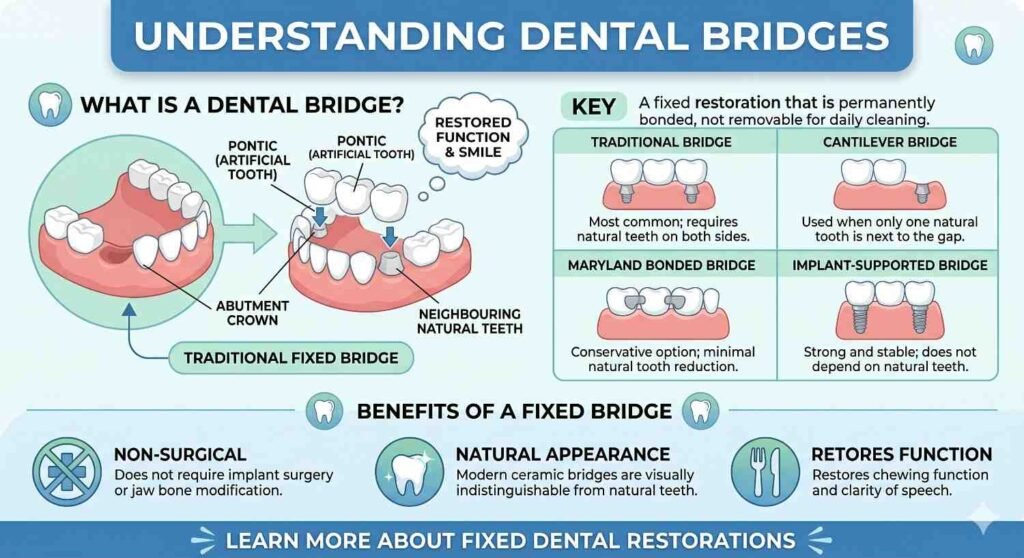
A bridge for teeth is a fixed dental restoration that replaces one or more missing teeth by suspending an artificial tooth — called a pontic — between two abutment crowns cemented onto the neighbouring natural teeth. The result is a single, permanently bonded unit that restores chewing function, speech, and smile appearance without implant surgery.
Key facts at a glance:
- A dental bridge does not require surgical implant posts or jaw bone modification
- The replacement tooth (pontic) is held in place by crowns fitted over the teeth on either side of the gap
- Modern ceramic bridges are visually indistinguishable from natural teeth
- Bridge types include: traditional, cantilever, Maryland bonded, and implant-supported designs
- A fixed bridge is permanently cemented and is not removed for daily cleaning
Patients seeking to evaluate their suitability for fixed bridgework can forward current radiographic imaging to our clinical coordination team via WhatsApp for a preliminary prosthodontic assessment.
What Is a Dental Bridge? — Entity Definition
What is a bridge for teeth, and how does it differ from other tooth replacement options?
A dental bridge is a fixed prosthetic device used in restorative dentistry to replace one or more missing teeth. It works by anchoring an artificial tooth — the pontic — between two retainer crowns placed over the natural teeth adjacent to the gap. When evaluating restorative pathways, clinical outcomes often depend on the choice between implants vs bridging of teeth to determine which restoration lasts longer for the patient’s specific anatomy.
In dental terms, a bridge is classified as a fixed prosthesis — meaning it stays in the mouth at all times and functions as part of the natural dentition. It is not the same as a removable bridge (removable partial denture), which is taken out for cleaning.
The term bridgework — also written bridge work on teeth — refers to this complete restoration system: the pontic, the abutment crowns, and the connectors that link them into a single oral prosthesis.
What is a bridge in dental terms, specifically? It is a fixed prosthesis engineered by a prosthodontist to match the patient’s existing dental anatomy, occlusion pattern, and bite force requirements. The restoration is designed as a load-bearing system — not simply a cosmetic gap filler.
What Is a Pontic Tooth?
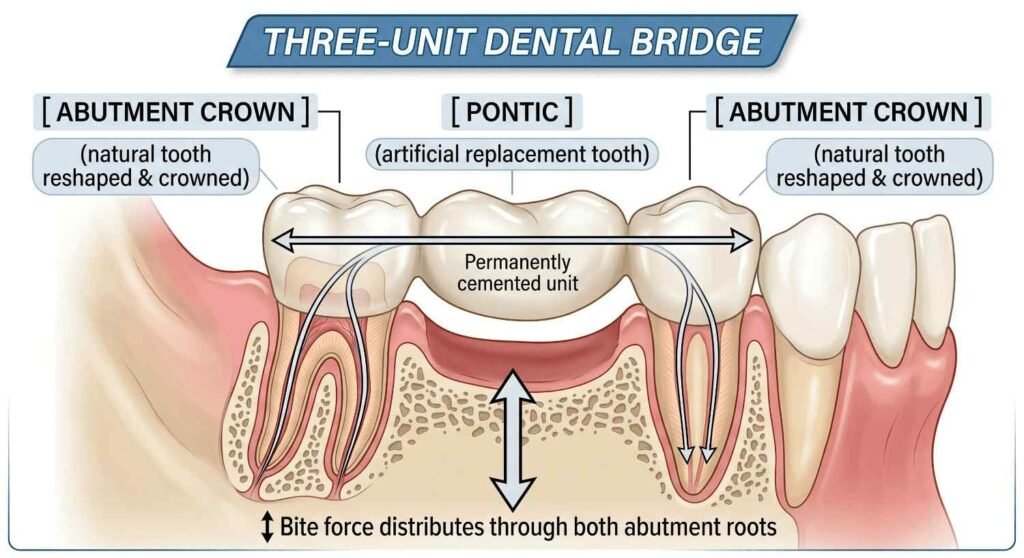
A pontic tooth is the artificial replacement tooth within a dental bridge. It occupies the space left by the missing tooth and is suspended between the two abutment crowns.
A pontic is shaped and colour-matched to resemble the natural tooth it replaces. It contacts the gum tissue lightly at its base — a design called a ridge lap — to create the appearance of a tooth emerging naturally from the gum line.
What Are Abutment Teeth?
Abutment teeth are the natural teeth that sit on either side of the gap and serve as anchors for the bridge crown on each side. They are prepared (reshaped) by the prosthodontist to receive the retainer crowns that hold the bridge in place. In advanced restorative cases, the mechanical role of the abutment in dental implants follows a similar principle, providing the structural connection between the root-replacement post and the final prosthesis.
Structural Assessment: To confirm if your adjacent natural teeth possess the necessary integrity to serve as abutments, submit an X-ray through our secure WhatsApp portal
Dental Bridge Anatomy — Visual Entity
What Does a Dental Bridge Look Like?
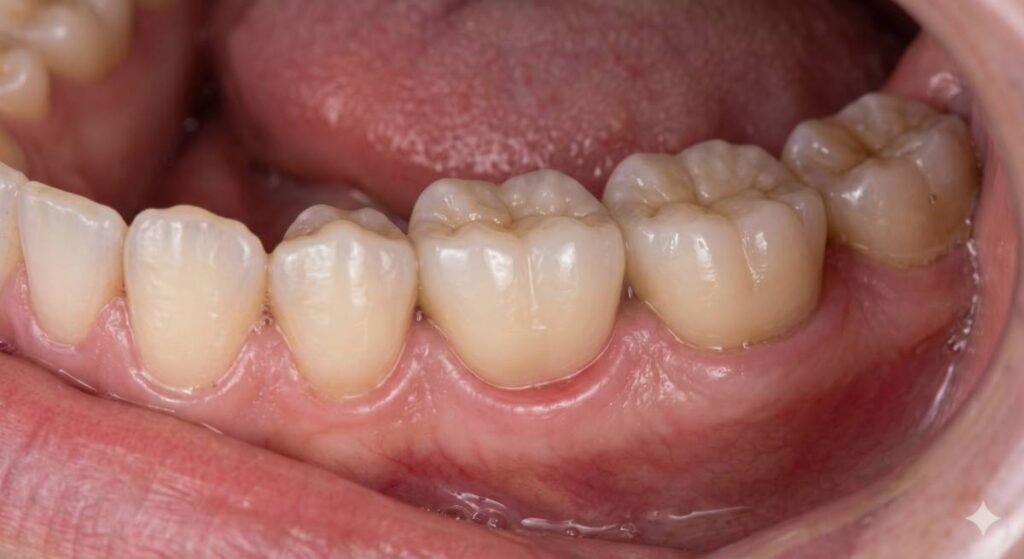
A well-made dental bridge is designed to be visually indistinguishable from the surrounding natural teeth. Modern ceramic restoration materials replicate the colour gradient, surface texture, and light transmission of natural enamel with clinical precision.
What Does a Bridge Tooth Look Like?
The pontic tooth is shaped to match the size, contour, and colour of the missing tooth and its neighbours. It has a natural-looking crown above the gum line and a softly curved underside that rests against the gum tissue. Under normal social conditions — conversation, smiling, eating — a bridge tooth is not distinguishable from a natural tooth. Clinical magnification is usually required to identify the margin lines where the crowns meet the abutment teeth.
What Does a Bridge Look Like on Teeth?
A bridge on teeth appears as two or three connected teeth that function as one unit. From the front, the only visible element is the pontic — which looks like any other tooth. The retainer crowns covering the abutment teeth also resemble natural tooth crowns. The bridge sits flush against the gum line and does not create visible gaps or shadows when fabricated correctly.
What Does a Bridge in Your Mouth Look Like?
Inside the mouth, a fixed bridge feels and looks like natural teeth. It does not move, shift, or create pressure against the gum tissue. It cleans with normal brushing — plus a floss threader or interproximal brush to clean beneath the pontic where a toothbrush cannot reach. What a bridge in your mouth looks like day-to-day is simply: your own teeth, complete.
Aesthetic & Anatomical Consultation: For an evaluation of your anterior or posterior edentulous spaces, initiate a remote review using our diagnostic WhatsApp link
What Does a Bridge Do for Teeth? — Clinical Functions
A bridge for teeth restores oral function and prevents the structural collapse that follows missing teeth. Without a tooth replacement, the teeth on either side of the gap begin to drift. Opposing teeth over-erupt into the empty space. These movements alter the bite permanently and are difficult to reverse without further treatment.
What does a bridge do for teeth, specifically:
- Restores chewing ability and distributes bite force evenly across the dental arch
- Maintains the position of adjacent teeth, which would otherwise shift into the empty space over time
- Preserves facial structure by reducing bone resorption. In cases of significant atrophy, practitioners may recommend bone grafting for dental implants to restore the necessary ridge volume before proceeding with a fixed restoration.
- Restores natural speech patterns — particularly sounds that require upper tooth surfaces such as “s,” “f,” and “v”
- Re-establishes correct occlusion between upper and lower arches
- Improves smile aesthetics immediately, without a surgical waiting period
A bridge acts as a physical barrier that maintains the architecture of the dental arch and prevents the progressive cascade of movement that follows a single missing tooth.
Functional Evaluation: If you are experiencing occlusal drift or masticatory dysfunction due to missing teeth, send your case details to our prosthodontics WhatsApp channel for clinical guidance.
What Are the Different Types of Dental Bridges?
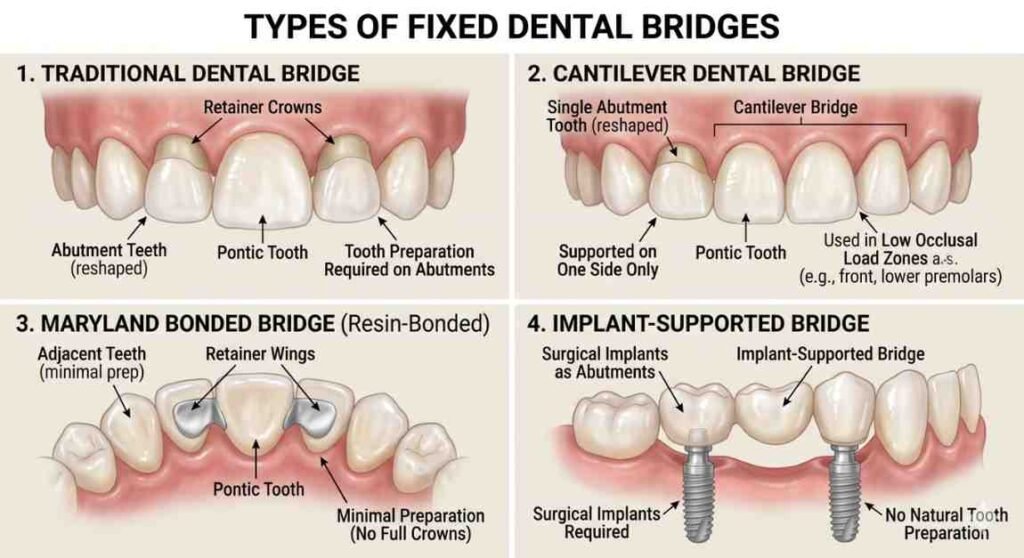
There are four main dental bridge types used in modern restorative dentistry. The appropriate design depends on the location of the missing tooth, the condition of the adjacent teeth, and the patient’s occlusal load.
Traditional Dental Bridge
The traditional dental bridge is the most common and evidence-backed design. It consists of a pontic tooth flanked by full retainer crowns on both adjacent abutment teeth — typically forming a three-unit dental restoration for a single missing tooth. It is indicated when healthy abutment teeth exist on both sides of the gap and when the bite force in that area is moderate to high. Traditional bridges fabricated from high-strength materials—such as a zirconia dental bridge—can withstand full posterior chewing forces and have documented lifespans exceeding 15 years.
Cantilever Dental Bridge
A cantilever bridge uses only one abutment tooth for support, rather than two. It is indicated when only one adjacent tooth exists beside the gap — most commonly in anterior (front tooth) zones or lower premolar areas where occlusal forces are lower. Because the pontic is supported on only one side, cantilever bridges generate leverage forces on the single abutment tooth. Careful occlusion analysis is required before placement to confirm the abutment can sustain these forces safely over time.
Maryland Bonded Bridge
A Maryland bonded bridge (also called a bonded bridge or resin-bonded bridge) uses a porcelain or metal framework bonded to the inner surfaces of the neighbouring teeth — rather than full crowns placed over them. This preserves most of the natural tooth structure of the adjacent teeth, making it the preferred conservative option for young adult patients or those with intact, unrestored neighbouring teeth. Maryland bridges are best suited for anterior gaps with low occlusal load. They are not recommended for posterior positions where chewing forces are high.
Implant-Supported Bridge
An implant-supported bridge uses surgically placed dental implant posts as the abutment anchors — rather than natural neighbouring teeth. This design is considered where adjacent teeth are missing or too compromised to serve as abutments. For a full breakdown of surgical anchoring options, see our detailed guide on what types of dental implants are utilized in modern prosthodontics.
Modern material science has also introduced a choice in frameworks; for example, patients often compare the durability of traditional metals against titanium vs zirconia dental implants when selecting the foundation for an implant-supported bridge.
Bridge Type Comparison — At a Glance
| Bridge Type | Abutment Source | Tooth Preparation | Best Indication |
|---|---|---|---|
| Traditional | Natural teeth (both sides) | Full crowns required | Single posterior or anterior gap, healthy neighbours |
| Cantilever | Natural tooth (one side only) | Full crown on one tooth | Anterior gap, one neighbour missing |
| Maryland Bonded | Natural teeth (wing-bonded) | Minimal — no full crowns | Anterior gap, intact unrestored neighbours |
| Implant-Supported | Implant posts | No natural tooth prep | No suitable natural abutments |
Material & Design Selection: To determine which bridge architecture is clinically indicated for your specific bite force parameters, request a case analysis via our direct WhatsApp line
What Is a Fixed Bridge? — Permanent vs Removable
A fixed bridge — also called a permanent bridge or fixed dental prosthesis — is a dental bridge that is permanently cemented into the mouth using dental cement. It cannot be removed by the patient for cleaning or sleeping. The terms fixed bridge, permanent bridge, and fixed dental prosthesis are used interchangeably in clinical practice.
What are fixed bridges, compared to removable alternatives?
| Feature | Fixed Bridge | Removable Partial Denture |
|---|---|---|
| Removal for cleaning | No — stays in permanently | Yes — removed daily |
| Stability during eating | High — does not shift | Variable — can lift or move |
| Feels like natural teeth | Yes | Requires adaptation period |
| Adjacent tooth preparation | Crowns on abutment teeth | Clasps on adjacent teeth |
| Bone stimulation beneath gap | Partial (via abutments) | Minimal |
What are the different types of bridges for teeth when it comes to removability?
There is only one non-removable category — the fixed bridge — and one removable category, the partial denture. All clinical bridge designs (traditional, cantilever, Maryland, implant-supported) fall within the fixed bridge category. A removable bridge is not a bridge in the prosthodontic sense — it is a partial denture that some patients colloquially call a bridge.
What Is a Partial Bridge for Teeth?
A partial bridge for teeth refers to a bridge that replaces fewer than a full arch of missing teeth — typically one to three adjacent teeth. For gaps spanning many missing teeth or full arches, different restorative pathways — such as implant-supported dentures or All-on-4 dental implants — are typically more appropriate than extended bridge spans.
Most standard dental bridges are, by definition, partial restorations. A three-unit bridge replacing one missing tooth is the most common form. Longer-span bridges replacing two or three adjacent teeth are also classed as partial bridges, using additional abutment support points. For gaps spanning many missing teeth or full arches, different restorative pathways — such as implant-supported dentures or All-on-4 — are typically more appropriate than extended bridge spans.
Prosthetic Transition Review: Patients looking to transition from a removable partial denture to a fixed restoration can verify their clinical candidacy through our WhatsApp case submission portal
Who May Need a Dental Bridge?
A dental bridge may be clinically appropriate for patients who:
- Are missing one tooth or several adjacent teeth in the same zone
- Have healthy, structurally sound natural teeth on both sides of the gap (for traditional or cantilever designs)
- Prefer to avoid surgical implant procedures or are medically contraindicated for surgery
- Want tooth replacement completed within a short timeframe without a surgical healing period
- Have a gap that has been present long enough for adjacent teeth to begin shifting
A prosthodontist evaluates the abutment teeth, the bite relationship, occlusal forces, and the available bone structure before recommending a specific bridge type or material. If the adjacent teeth are heavily restored, periodontally compromised, or absent, implant-based alternatives may be more appropriate for long-term outcomes.
Dental Bridge Glossary — Key Terminology
What are the different types of bridges for teeth when it comes to removability?

Frequently Asked Questions About Dental Bridges
What is a dental bridge used for?
A dental bridge is used to replace one or more missing teeth, restore chewing function, improve speech, prevent adjacent teeth from shifting, and restore smile appearance — without requiring dental implant surgery. It is the primary non-surgical fixed prosthesis in restorative dentistry.
How does a dental bridge work?
A dental bridge works by anchoring a pontic (artificial tooth) between crowns placed on the adjacent teeth. Chewing forces are transferred through the crowns into the abutment teeth and their roots, restoring bite force distribution similar to a natural tooth.
Can a dental bridge replace multiple teeth?
Yes. Extended-span bridges can replace two or three adjacent missing teeth using additional abutment support. For larger gaps or full arches, implant-based solutions are typically more appropriate.
What are dental bridges made of?
Modern dental bridges are made from high-strength ceramic restoration material, porcelain-fused-to-metal (PFM), or resin-bonded frameworks for Maryland bonded bridge designs. Material selection depends on tooth location, bite force, and aesthetic requirements. Your prosthodontist will recommend the appropriate material for your specific dental anatomy — for a full breakdown of options, see our dental bridge materials guide.
What is the difference between a fixed bridge and a removable bridge?
A fixed bridge is permanently cemented using dental cement and cannot be removed by the patient. A removable bridge (removable partial denture) can be taken out for cleaning. Fixed bridges generally provide greater stability, a more natural feel, and stronger bite force support.
What are the different types of bridges for teeth?
The four main dental bridge types are: traditional (three-unit, two abutments), cantilever (single abutment), Maryland bonded bridge (wing-bonded bridge, no full crowns), and implant-supported (bridge support from implant posts).
In dentistry, what is a bridge — and when is it not the right choice?
In dentistry, a bridge is the correct choice when adjacent teeth are structurally sound, the gap spans one to three teeth, and the patient prefers a non-surgical fixed prosthesis. It may not be optimal when abutment teeth are heavily restored, periodontally compromised, or absent — in which case a prosthodontist will typically recommend implant-based tooth replacement instead.
Expert Insight: Why Bridge Anatomy Is Not Just Cosmetic
Many patients assume a dental bridge is simply a “fake tooth” placed into a gap. In clinical practice, bridgework is a carefully engineered prosthetic restoration system that must account for bite force distribution, occlusion load, abutment tooth strength, and long-term material durability.
Understanding terms such as pontic, abutment, and occlusion allows patients to engage more meaningfully with their restorative dentistry treatment plan — and to make informed decisions between bridge and implant pathways based on their own oral prosthesis needs and dental anatomy.
The abutment in dental implants works on a similar mechanical principle to abutment teeth in bridgework — both serve as load-bearing anchors for the prosthetic restoration above them.