
Medically Reviewed — May 2026 | Dr. Anas Zemzemi, DDS — Oral Implantology & Reconstructive Dentistry | Kristal Clinic Istanbul
Mini dental implants vs traditional implants — also searched as mini dental implants vs regular implants or mini dental implants vs conventional implants — compares two different implant systems: narrow one-piece posts for limited bone or denture stabilization, and wider two-piece implants for long-term fixed tooth replacement. , built for narrow bone or overdenture retention. Traditional implants use a two-piece post-and-abutment system at 3.5 to 6mm, built for permanent single-tooth and fixed-arch restorations. The core difference between mini and regular dental implants lies in structural diameter, bone volume requirements, load-bearing capacity, and clinical lifespan.
Quick Answer
Mini dental implants vs traditional implants differ in diameter (1.8–3mm vs 3.5–6mm), design (one-piece vs two-piece), and clinical application. Traditional implants deliver superior long-term load capacity for permanent tooth replacement. Mini dental implants provide a minimally invasive alternative for patients with limited bone width or those needing to stabilize loose dentures without bone augmentation.
Not sure which system fits your anatomy? The Kristal Clinic team reviews CBCT scans and X-ray images remotely. Request a no-obligation pre-assessment before you travel.
Table of Contents
ToggleMini vs Regular Dental Implants: Bone Density and Bone Graft Requirements
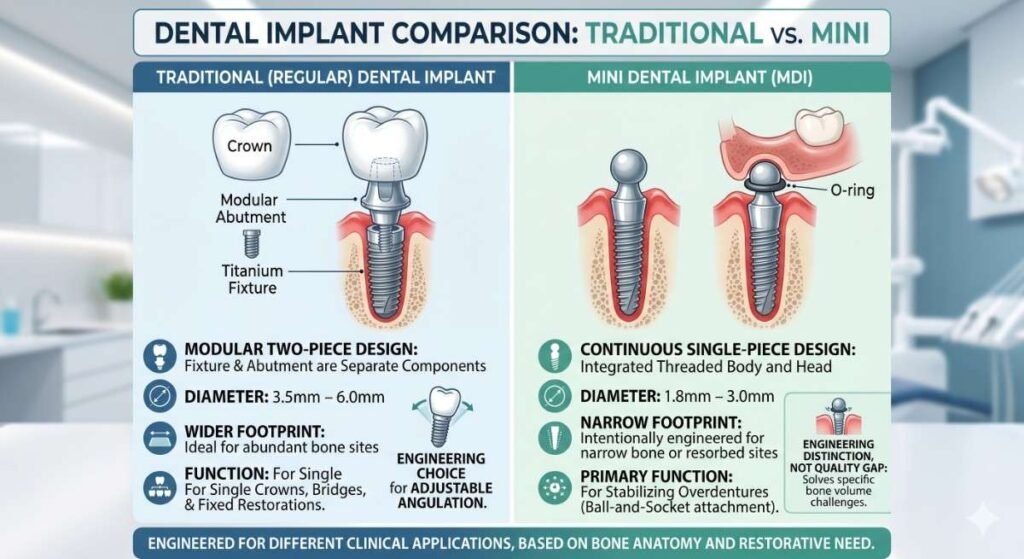
Mini dental implants (1.8–3mm diameter, single-piece design) are physically narrower and structurally simpler than traditional implants (3.5–6mm, two-piece post-and-abutment system), making them the correct clinical choice for anatomically narrow sites where standard placement is not possible.
The difference between mini and regular dental implants is not a quality gap — it is an engineering distinction. Traditional implants use a modular two-piece design: a titanium fixture integrates below the gumline, then a separate abutment screw connects to support the crown. This modularity lets the clinician fine-tune the restorative angle and material independently. For a deep dive into patient selection, durability metrics, and systemic indications for these fixtures, see our complete clinical guide to mini dental implants. They are manufactured as a continuous single piece — the threaded body and ball-shaped retaining head are one integrated unit. The reduced footprint is an intentional engineering choice for narrow or resorbed bone, not a structural compromise.
For a full overview of where MDIs sit in the implant spectrum, see types of dental implants.
| Structural Property | Standard Traditional Implant | Mini Dental Implant (MDI) |
|---|---|---|
| Implant diameter | 3.5mm to 6.0mm | 1.8mm to 3.0mm |
| Structural design | Two-piece: post + separate abutment | Single-piece: integrated thread + ball head |
| Material | Titanium Grade 5 / Roxolid / Zirconia | Solid titanium alloy (high tensile) |
| Surgical profile | Flap incision, multi-stage osteotomy | Minimally invasive flapless technique |
| Bone contact surface | High — wide osseointegration zone | Reduced — narrower bone-implant interface |
| Prosthetic interface | Screw- or cement-retained crown | O-ring snap or narrow fixed prosthetic |
Material selection across both systems is covered in detail in the dedicated titanium vs zirconia implants guide.
Are Mini Implants Stronger Than Traditional Implants? Force and Load Limits
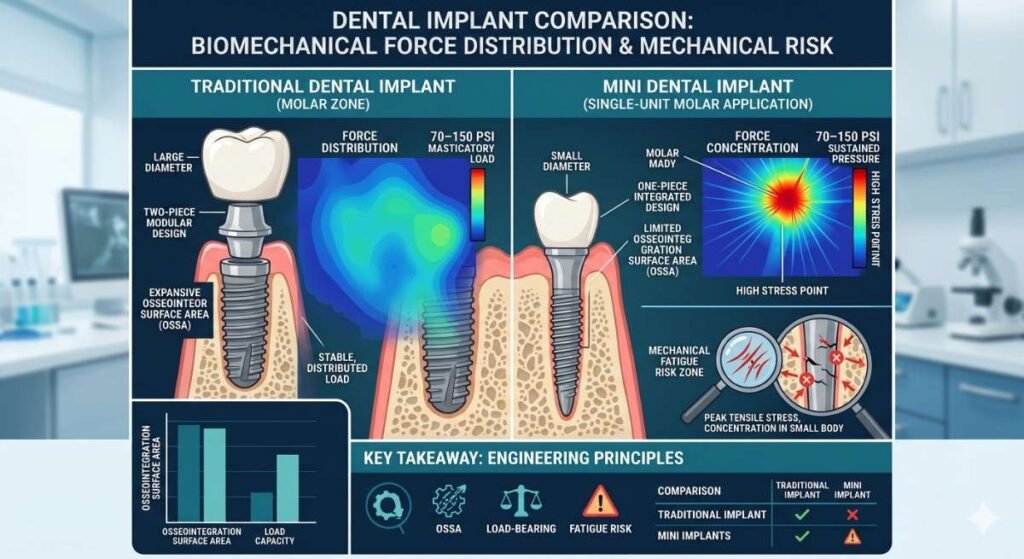
Traditional dental implants are stronger and provide higher load-bearing capacity across major chewing zones due to their larger osseointegration surface area and two-piece design, whereas mini dental implants carry a higher mechanical fatigue risk when subjected to sustained individual molar pressures.
This is an engineering problem of force distribution. The human bite generates 70–150 psi of masticatory force at the molar zone. Implant stability under this force depends on total bone-to-implant contact area and the tensile properties of the implant body.
Traditional implants optimize both. Their wider implant diameter creates a larger osseointegration surface that distributes chewing forces evenly across a greater bone area over decades. Mini dental implants rely on a narrower footprint. Their precision threads deliver strong initial primary implant stability and excellent retention for low-to-moderate loads, but their reduced surface area concentrates stress at the implant neck under heavy molar loading — making standalone MDI placement at molar sites clinically unsuitable in most cases.
The practical rule: If the goal is a permanent single molar or fixed bridge, traditional diameter implants are the correct biomechanical choice.
Alternative indicator: If the goal is denture retention or a narrow anterior restoration, the load requirements are within the MDI’s validated range.
A full clinical account of where these mechanical limits matter most is in the disadvantages of mini dental implants guide.

Healing Time Compared: How Long Until Each Implant Is Fully Stable?
Traditional implants require 3 to 6 months of undisturbed osseointegration before final crown placement, whereas mini implants can support a functional restoration on the same day using immediate loading protocols, provided primary stability thresholds are met at placement.
For traditional two-piece implants, the fixture is left undisturbed beneath the gumline while osteoblasts form a direct structural bond with the titanium surface over 3 to 6 months. Loading before this window risks micromovement that prevents full integration.
Immediate loading implants — the MDI protocol — rely on mechanical friction and insertion torque (typically ≥30 Ncm) rather than biological integration alone at the point of restoration. Full osseointegration still occurs over subsequent months, but the patient leaves the clinic with a functional prosthetic on day one.
| Clinical Variable | Traditional Implant | Mini Implant (MDI) |
|---|---|---|
| Peak bite force capacity | High — distributed across wide surface | Moderate — concentrated on narrower contact |
| Molar zone suitability | Fully indicated | Contraindicated as standalone molar |
| Mini implants vs traditional implants success rate | 95–98% at 10 years | 85–92% at 5–8 years in correct indications |
| Osseointegration window | 3–6 months before final loading | Immediate loading possible; integration ongoing |
| Healing complexity | Multi-stage | Single-stage, minimal downtime |
Bidra AS, Almas K. Mini implants for definitive prosthodontic treatment: a systematic review. J Prosthet Dent. 2013. | Shatkin TE et al. Mini dental implants for long-term fixed and removable prosthetics. Compend Contin Educ Dent. 2007.
Mini Dental Implants vs Traditional Pros and Cons: By Treatment Goal
Traditional implants provide premium structural longevity, optimal aesthetic crown matching, and maximum chewing power. Mini dental implants deliver faster recovery via immediate loading protocols and a less invasive procedure profile for patients with reduced surgical tolerance.
This is a matching exercise, not a competition. To figure out if the financial and surgical trade-offs align with your specific goals, understanding whether are mini dental implants worth it value best candidates 2026 is a critical first step. The correct implant system is always the one whose mechanical profile and surgical demand align perfectly with the patient’s anatomy.
| Category | Traditional Implant | Mini Dental Implant |
|---|---|---|
| Primary benefit | Permanent individual roots for fixed restorations | Bypasses augmentation; rapid functional restoration |
| Surgical experience | Multi-stage, structured healing window | Single-stage, immediate loading implants |
| Best-match anatomy | Healthy or graftable bone | Atrophic, narrow, or resorbed ridges |
| Restoration type | Permanent crown or fixed bridge | Overdenture retention or narrow fixed prosthetic |
| Lifespan expectation | 20+ years (95–98% at 10 years) | 10–15 years in correct indications |
| Implant success rate | Highest in correct indications | Strong within validated applications |
Mini Dental Implants for Seniors vs Traditional Options
Mini dental implants for seniors are frequently the safer and more practical choice because age-related bone resorption and systemic health factors that elevate traditional surgical risk can be managed through the flapless, minimally invasive MDI placement protocol.
Two physiological realities converge in older patients: declining bone density reduces ridge width available for standard-diameter posts, and systemic conditions (cardiovascular management, type 2 diabetes, anticoagulant therapy) elevate the risk profile of extended flap procedures. The MDI flapless placement eliminates incision and suturing, dramatically reducing surgical trauma. For a patient in their 70s whose goal is stable dentures rather than a permanent crown, the risk-benefit calculation clearly favours the mini implant system.

Mini Dental Implants for Dentures vs Traditional Implants: Functional Stability
Mini implants are FDA-cleared and clinically validated for lower overdenture stabilization — acting as friction-fit retaining anchors that prevent denture movement — but they cannot replace traditional implants or multi-post systems for complete fixed-arch reconstruction.
This distinction matters because patients frequently conflate two different prosthetic goals. Traditional implants function as independent structural roots. Each implant independently bears a share of total masticatory force — the prosthetic is fixed and the gum tissue plays no mechanical role.
Mini dental implants for dentures function as a retention system, not a primary load-bearing system. The ball head snaps into an O-ring socket in the denture base, preventing sliding and rocking. The gum tissue continues to cushion primary biting forces. This is why mini dental implants for dentures vs traditional implants is correctly understood as a comparison between a retention mechanism and a structural root system — not competing solutions to the same problem.
For patients pursuing fixed full-arch reconstruction, All-on-4 dental implants is the dedicated clinical system for that goal. For an in-depth look at how mini implants interact with denture prosthetics specifically, the Can Mini Implants Support Dentures cluster page covers the mechanics in full.
| Functional Parameter | Traditional (Fixed Arch) | Mini Implant (Overdenture Retention) |
|---|---|---|
| Prosthetic type | Fixed, non-removable | Removable overdenture with snap retention |
| Load-bearing role | Carries 100% of masticatory force | Provides retention; gum tissue shares load |
| Bone volume required | Significant | Minimal — built for resorbed ridges |
| Patient removability | No | Yes — removable for cleaning |
| FDA clearance scope | Full range | Validated for overdenture stabilization |
The Kristal Clinic clinical team reviews CBCT scans and panoramic X-rays remotely for international patients. Upload your imaging and receive a personalized treatment pathway before your visit to Istanbul. Request Remote Assessment | WhatsApp Medical Porta
Which Is Better: Mini or Traditional Dental Implants? The Final Clinical Verdict
Choosing between mini and traditional dental implants requires matching available bone volume to structural demands: traditional implants are the correct choice for permanent individual tooth roots and fixed bridges; mini implants are the validated alternative for securing loose dental appliances in narrow or resorbed bone.
Neither system is universally superior. The difference between mini and regular dental implants resolves into a clinical matching problem — anatomy and prosthetic goal determine the answer, not a ranking of one product over another. Detailed diagnostics must evaluate a patient’s absolute eligibility beforehand; you can read about bone benchmarks and health exclusions in our guide on who is a candidate for mini dental implants eligibility criteria 2026.
| Clinical Variable | Traditional Two-Piece Implants | Mini One-Piece Implants (MDIs) |
|---|---|---|
| Primary indication | Single tooth replacement / fixed bridges | Removable overdenture retention |
| Minimum bone width | ≥5.5mm | As narrow as 2.5–3mm |
| Bone graft frequency | Common when ridge is resorbed | Rarely required |
| Mechanical role | Carries 100% of bite force | Stabilizes mobile appliances |
| Treatment window | 3–6 months to final restoration | Often single-visit with immediate loading |
| How long do mini dental implants last vs regular | 20+ years | 10–15 years in correct indications |
| Surgical complexity | Moderate to high | Low — minimally invasive |
For patients evaluating financial planning, surgical complexity, and restoration costs, our detailed Mini Dental Implant Cost guide explains the major pricing variables in detail.
Frequently Asked Questions
Are mini dental implants as good as regular implants?
For stabilizing loose dentures or treating patients with severe bone resorption, mini dental implants deliver successful clinical outcomes within their validated indications. For standalone single tooth replacement or fixed bridges requiring maximum biting strength, traditional two-piece implants remain the clinical benchmark due to their wider osseointegration surface and superior long-term load distribution. Neither system is universally better — the anatomy and prosthetic goal determine the correct match.
What is the failure rate of mini dental implants?
Mini dental implants have a reported failure rate of approximately 8–15%, depending on placement site, bone density requirements, and prosthetic application. Traditional implant success rate data shows 2–5% failure over a 10-year period, attributable to greater osseointegration surface area and better force distribution.
(Source: Bidra & Almas, J Prosthet Dent, 2013; Shatkin et al., Compend Contin Educ Dent, 2007)
What is the life expectancy of mini dental implants?
How long do mini dental implants last vs regular implants is one of the most searched comparison questions. Mini dental implants typically demonstrate a clinical lifespan of 10–15 years in anatomically appropriate sites with consistent maintenance. Traditional implants routinely exceed 20 years, with survival rates above 95% at the 10-year mark. The gap reflects the difference in load each system is engineered to manage.
(Source: Pjetursson BE et al., Clin Oral Implants Res, 2004)
Which is better — mini implants or traditional dental implants?
Neither. Mini dental implants vs traditional implants is correctly understood as a system-matching problem. Traditional implants are the correct choice for permanent fixed restorations where bone is sufficient. Mini dental implants for seniors, patients with significant bone loss, or those needing denture stabilization without grafting are the populations where the MDI system delivers the most clinical value.
Summary
The mini dental implants vs traditional implants comparison resolves into a clean clinical framework: two different tools engineered for two different anatomical and prosthetic scenarios.
Traditional implants deliver unmatched longevity, load capacity, and aesthetic versatility for permanent tooth replacement in patients with sufficient bone. Mini dental implants provide a validated, minimally invasive pathway to restore function in patients whose anatomy, age, or health profile makes full surgical implant protocols impractical.
Begin with a CBCT scan. A qualified implantologist will determine within that assessment which system your anatomy supports — and in many cases, a combination of both across different sites represents the most efficient treatment plan.
The Kristal Clinic clinical team in Istanbul offers remote pre-consultation assessments for international patients. Submit your imaging to receive a personalized treatment proposal before you travel.
[Request Remote Assessment] | [Open WhatsApp Medical Portal]
- Bidra AS, Almas K. Mini implants for definitive prosthodontic treatment: a systematic review. J Prosthet Dent. 2013;109(3):156–164.
- Shatkin TE, et al. Mini dental implants for long-term fixed and removable prosthetics: a retrospective analysis of 2514 implants. Compend Contin Educ Dent. 2007;28(2):92–99.
- Pjetursson BE, et al. A systematic review of the survival and complication rates of fixed dental prostheses (FDPs) after an observation period of at least 5 years. Clin Oral Implants Res. 2004;15(6):625–642.
- FDA 510(k) clearance documentation for mini dental implant systems.
- ITI Consensus Statements on standard implant diameter and loading protocols (International Team for Implantology).
Medical Reviewer: Dr. Anas Zemzemi, DDS | Last Clinical Review: May 2026
Medical Disclaimer: This article is for educational purposes only and does not constitute medical advice, a clinical diagnosis, or a treatment recommendation. Implant suitability is determined by individual clinical assessment including CBCT imaging and systemic health review. Consult a qualified implantologist before any treatment decision.